Table of Content

Spaceman by Pragmatic Play: Complete Crash Game Review, Auto Cashout Mechanics and Strategy Guide for Australian Players

Last updated: February 2026 | Reviewed by: Claire Bennett, senior casino content editor (editorial persona) | Reading time: ~30 minutes

Responsible gambling notice (18+): This guide is general information only and is not financial, legal or clinical advice. Gambling involves real financial risk, and losses can exceed expectations. Never wager money you cannot afford to lose. If gambling is causing harm to you or someone you know, contact Gambling Help Online on 1800 858 858 (available 24/7 in Australia) or register with the national self-exclusion register, BetStop.

Provider

Pragmatic Play

RTP

96.50%

Volatility

High

Min bet

$1

Max bet

$100

Max win

$500,000

Spaceman by Pragmatic Play Complete Crash

Spaceman in Sixty Seconds

Spaceman is a crash game from Pragmatic Play with a 96.50% RTP, a bet range of $1 to $100, a maximum multiplier of 5,000x and a payout cap of $500,000. It has no reels, no paylines, no Spin button, no free spins, no scatter or wild symbols and no Bonus Buy, a point that several widely-read reviews get factually wrong. Your only decisions are how much to stake and when to press Cash Out.

Its single genuinely distinctive feature is 50% Auto Cashout, which banks half your stake at a multiplier you nominate while the remaining half keeps flying. Used carefully, it converts a binary win-or-lose bet into a partial hedge. Used carelessly, it simply increases the number of rounds you play, and therefore your total exposure to the house edge.

Spaceman in Sixty Seconds. Spaceman is

Who This Spaceman Guide Is For

Most people who search for this game want one of three things. Some want to try spaceman demo before spending a cent. Some want to know whether spaceman real money play is even available to them in Australia, and on what terms. Others already have an account and want the numbers: RTP, limits, bonus weighting, withdrawal reality.

This guide answers all three, in that order of caution. We put the mechanics and the maths first, the strategy discussion second, and the risk and regulatory material where you can actually see it rather than buried in a footer. If you are comparing crash titles, section 10 sets Spaceman against Aviator and JetX. If you only want the short verdict, jump to section 17.

One more thing before we start. We have flagged, in plain language, every figure we could not verify to our own standard. Appendix A lists them. That is deliberate: a review that never admits uncertainty is usually hiding some.

Who This Spaceman Guide Is For

1. Spaceman at a Glance: Verified Game Parameters

The table below is the single most important block on this page. It has been cross-checked against multiple independent listings and stripped of the errors that appear in competing reviews, in particular the phantom "3 reels" entry that circulates on at least one high-traffic aggregator despite Spaceman having no reels whatsoever.

ParameterValueNotes
DeveloperPragmatic PlayIn-house crash title, not a licensed white-label
Release date28 March 2022Some listings show 24 March or 8 February 2022; 28 March is the date used most consistently in the provider's own release communications
Game typeCrash game / instant winNo reels, no rows, no paylines, no Spin button
RTP96.50%Fixed theoretical return over the long run
VolatilityHigh (structurally)No provider volatility index is published; dispersion is driven by your chosen cash-out point
Minimum bet$1.00 (€1.00 / £1.00)Operator currency and limits may vary
Maximum bet$100.00 (€100.00 / £100.00)Hard ceiling, and critical for strategy planning
Maximum multiplier5,000xRound pays out automatically if 5,000x is reached
Maximum win$500,000Per-bet payout cap ($100 × 5,000x)
Free spinsNoneNot a slot; no spin-based bonuses exist
Bonus roundsNoneAll winnings come from the main round multiplier
Bonus BuyNot availableNo feature purchase mechanic
Progressive jackpotNoThe 5,000x cap is a fixed ceiling, not a pooled jackpot
Signature featuresAuto Cashout, 50% Auto Cashout, Double Bet, live statistics, history ticker, live chat, winners table50% Auto Cashout is the mechanic that most clearly separates Spaceman from Aviator and JetX
MultiplayerYes, synchronous roundsAll players in the round share the same crash point
Round lengthRoughly 10 to 30 seconds in typical observationApproximate; the provider publishes no official duration figure, so treat as an observational estimate rather than a specification
Betting window10-second countdown between roundsBets must be confirmed before launch
PlatformHTML5: desktop, tablet, mobile browserNo dedicated app required
Demo modeYes, free play with virtual creditsAvailable on most casino lobbies and review sites

Two-sentence summary: Spaceman is a fixed-RTP crash game where a multiplier rises from 1.00x until a randomly determined crash point ends the round. Your stake, your cash-out timing and your use of the 50% partial cashout are the only variables under your control.

A note on conflicting maximum-win claims

You will encounter third-party pages quoting caps of 1,000x or 2,000x for Spaceman. Provider marketing materials for crash titles are updated over time, and some regional operator builds apply their own table limits, which explains part of the divergence. The overwhelming consensus across independent reviews and casino lobbies is 5,000x with a $500,000 payout ceiling, and that is the figure we use throughout this guide.

Because operator-side limits can and do differ, always open the in-game information panel (the "i" icon) in the specific lobby where you intend to play spaceman, and confirm the maximum multiplier, maximum win and bet range before you place a real-money wager. It takes fifteen seconds and it settles the question for your account, not for someone else's.

A note on conflicting maximum-win claims

2. Common Myths and Factual Errors in Other Reviews

Crash games sit awkwardly in casino affiliate taxonomies, and the result is a body of published content that describes Spaceman using slot vocabulary it does not deserve. Before going further, it is worth clearing the record, because these errors materially mislead new players about what they are buying into.

Claim you may have readStatusThe reality
"Reels: 3"FalseSpaceman has no reels at all. The interface shows an ascending character and a live multiplier. Nothing spins.
"Spin the reels and if you are lucky you will hit a bonus!"FalseThere is no Spin button and no bonus round. You confirm a bet, then cash out manually or automatically.
"Paylines: crash"MeaninglessThere are no paylines. Payout equals stake × multiplier at cash-out.
"Win free spins in Spaceman"FalseNo free spins, no scatters, no wilds, no respins.
"Release date 24/03/2022" (contradicted elsewhere by 28 March 2022)InconsistentUse 28 March 2022. Internal contradictions within a single review are a reliability red flag.
"Martingale is a recommended Spaceman strategy"Unsupported and dangerousThe $100 bet ceiling mathematically breaks doubling progressions after six steps from a $1 base. Many operators also prohibit progressive systems in their bonus terms.
"Volatility: low"MisleadingSpaceman has no provider-assigned volatility rating. Effective volatility is set by your target multiplier: a 1.20x target behaves like a low-variance game, a 50x target behaves like an extreme-variance one.
"Spaceman is a slot machine"Loose at bestIt is distributed through slot lobbies, but the mechanic is instant-win crash. Reviews that treat the spaceman slot label literally systematically fail to explain the features that actually matter.

Why does this matter beyond pedantry? Because a player who expects free spins will keep hunting for a feature that does not exist, and hunting usually means playing more rounds.

3. Spaceman as a Crash Game

Two-sentence summary: Crash games replace the reel-and-symbol architecture of slots with a single rising multiplier and a hidden termination point. The player's active decision, when to exit, creates a feeling of agency that the underlying mathematics does not reward.

3.1 Defining Spaceman and its Place among Crash Games

A crash game is built around one continuous variable. When a round begins, a coefficient starts at 1.00x and climbs. At some point, determined before the round even starts by a random number generator, the round terminates: the "crash". If you have cashed out before that instant, you are paid your stake multiplied by the coefficient at the moment you pressed the button. If you have not, your stake is lost in full.

Spaceman applies this template with a cartoon astronaut. Before launch, the character waits on a purple-hued alien horizon; when the countdown expires, he rises across the screen while the multiplier counter climbs alongside him. When the round ends, the sky flushes red and the character tumbles. There is no ambiguity in the outcome, and no interpretive layer of symbols, ways or paylines between the random event and your balance.

The genre's ancestry lies in crypto casino titles from the mid-2010s, popularised at scale by Spribe's Aviator. Pragmatic Play's entry in March 2022 mattered because it brought crash mechanics into thousands of mainstream, conventionally licensed casino lobbies that had previously only offered slots, table games and live dealer content. In the provider's portfolio, Spaceman is positioned as its flagship crash product rather than as an experimental side release.

Rounds in Spaceman typically last somewhere in the region of ten to thirty seconds from launch to crash, based on observation across sessions. Pragmatic Play does not publish an official round-duration specification, so read that range as an observational estimate rather than a technical parameter. It also varies enormously, because a 1.02x crash resolves in under two seconds while a 200x run can stretch well past thirty.


3.1 Defining Spaceman and its Place

3.2 Theme, Graphics and the Feel of the Gameplay

The presentation is deliberately minimal, and that is a design choice rather than a shortcut. A 2D animated astronaut, a starfield backdrop, a large central multiplier readout, and a control cluster along the left and bottom edges. The soundtrack builds in intensity as the multiplier climbs and cuts abruptly on the crash, a structural audio cue that reinforces both anticipation and loss salience.

Three social and informational layers surround the core loop:

  • History ticker:a horizontal strip of the most recent crash coefficients (typically the last 20 to 50), colour-coded by magnitude.
  • Statistics panel:aggregated distribution data for the current session's rounds.
  • Live winners table and chat:a real-time feed of other players' cash-outs and a chat channel, creating a shared, sometimes competitive atmosphere.
F88spins heading-banner

These elements are frequently glossed over in reviews that treat the game as a spaceman slot, yet they are central to the experience. The live winners table in particular means you routinely watch other people cash out at 30x while you banked at 1.50x, a social comparison mechanism with documented behavioural consequences that we return to in section 14.

Data-driven analyses of crash games show that, according to aggregated crash game analysis covering 2022 to 2025, over 78% of players lose money over time, even when they perceive their play to be skill-influenced. That gap between perceived skill and statistical reality is the defining psychological feature of the genre.

These elements are frequently glossed over

3.3 Multiplier Growth and Round Termination

The coefficient does not grow linearly. It accelerates: the gap between 1.00x and 2.00x consumes several seconds, whereas the gap between 50x and 100x passes in a blink. This is why late cash-outs are so difficult to execute manually, and why the Auto Cashout tool exists at all.

Critically, the crash point is pre-determined by the RNG before the round starts. Nothing you do during the flight, not the timing of your click, not the size of your stake, not whether you use partial cashout, changes where the crash will occur. Your input affects only whether you have exited before that fixed point.

The distribution of crash points is heavily weighted towards the bottom of the range. Most rounds terminate at relatively low multipliers, below roughly 2.00x, with long runs to high multipliers being rare but genuinely possible.

3.3 Multiplier Growth and Round Termination

«The probability of reaching 2x is approximately 48%, while 10x occurs in only about 9.65% of rounds, reflecting the exponential distribution of crash points.» Technical analysis of crash game mathematics (2024)

Those two numbers are worth internalising. A 48% chance of reaching 2.00x means a flat strategy targeting 2.00x wins slightly less than half the time, which is precisely how a 96.50% RTP is engineered. And a 9.65% chance of reaching 10x means that chasing 10x multipliers loses roughly nine rounds in ten.

3.4 How Spaceman Differs from a Classical Slot

DimensionClassical slotSpaceman (crash)
Core mechanicSpinning reels, symbol combinationsSingle rising multiplier
Player agency after committing stakeNoneCash-out timing decision
Result architecturePaylines, ways or clustersStake × exit multiplier
Round structureIndividual, self-paced spinsSynchronous multiplayer rounds on a shared timer
Bonus featuresFree spins, wilds, scatters, Bonus BuyNone
VolatilitySet by game mathsSet by the player's target multiplier
Social layerUsually absentChat, live winners, shared crash point
CeilingGame-specific max win5,000x / $500,000

4. Game Parameters: RTP, Volatility and Limits

Two-sentence summary: A 96.50% RTP means a 3.50% house edge applied to every dollar staked, irrespective of strategy. Volatility in Spaceman is not fixed by the provider; you choose it every time you set a target multiplier.

4.1 RTP and the House Edge

Spaceman returns a theoretical 96.50% of all money staked over an extremely large number of rounds. The complement, 3.50%, is the house edge. This figure is embedded in the crash-point distribution and cannot be altered by any pattern of play.

The practical implication is worth stating bluntly. Expected loss scales with total amount staked, not with the number of sessions or the apparent cleverness of your approach. Stake $2 per round across 500 rounds and you have wagered $1,000, with a theoretical expected loss of $35. Any strategy that increases the number of rounds you play, or the size of your stakes, increases that expected loss proportionally, no matter how it feels while you are playing.

A 96.50% RTP sits at roughly the industry average for online slots and marginally below Aviator's 97.00%. It is meaningfully better than most Australian land-based pokies in club and pub venues, but the comparison offers limited comfort: crash games compensate with round speed, and speed multiplies exposure.

4.1 RTP and the House Edge

4.2 Volatility, Crash Frequency and Short-Term Risk

Pragmatic Play does not assign Spaceman a volatility rating, and reviews that state "high volatility" or "low volatility" as a specification are inventing data. Structurally the game is high-variance, but the variance you personally experience is a direct function of your target:

Target multiplierApproximate hit rateExperience
1.20x~70 to 75%Frequent small wins, low variance, slow bankroll erosion
1.50x~62 to 65%Balanced, still fairly smooth
2.00x~48%Roughly coin-flip; the classic benchmark
5.00x~19%Long dry spells
10.00x~9.65%Nine losses in ten rounds is normal
50.00x+~2% or lessLottery-style; occurs in a small minority of rounds

Note that low-multiplier targeting does not beat the house edge. A 1.20x target with a ~72% hit rate returns 0.72 × 1.20 = 0.864 units per unit staked in that simplified illustration; the arithmetic only reconciles to 96.50% once the true underlying distribution and the instant-crash cases are modelled precisely. The point stands, though. No target multiplier is mathematically superior. Low targets trade a smoother ride for the same long-run expectation, while high targets trade brutal drawdowns for the chance of a session-defining spike.

Crashes below 1.20x appear strikingly often, and the intuitive explanation offered in player communities is that these frequent early terminations mathematically counterbalance the rare exponential runs. That reasoning is directionally consistent with an exponential crash-point distribution, but we have not been able to source a published provider-side model or independent simulation confirming the exact weighting for Spaceman specifically. Treat it as a plausible interpretation pending verifiable data rather than an established parameter.

The most important practical consequence: a crash can occur at 1.00x, effectively instantly, before any player has a realistic opportunity to press Cash Out. Any strategy that assumes you will always have time to exit at some minimum threshold is built on a false premise.

Note that low-multiplier targeting does not

4.3 Bet Range, Maximum Multiplier and the Payout Cap

The stake range runs from $1.00 to $100.00 per round, though individual operators may narrow this or convert it to local currency at slightly different thresholds. Australian players should check whether their operator's table limits differ from the provider defaults, because they sometimes do.

The $100 ceiling is strategically decisive, and it is the single most under-reported specification in competing reviews. It caps every progressive betting system dead. From a $1 base, doubling permits only six escalations ($1 → $2 → $4 → $8 → $16 → $32 → $64) before the seventh step ($128) exceeds the maximum permitted bet. We return to this in section 8.

The maximum multiplier is 5,000x. If a round reaches 5,000x, the game pays out automatically and you cannot stay in beyond it. The maximum win per bet is $500,000, achievable only from a $100 stake riding to the full 5,000x, an event of vanishing probability.
Fact check note: RTP, bet limits, maximum wins and available modes should be verified twice, first in the official Spaceman rules published by Pragmatic Play, then in the interface of the specific online casino you use. Operator builds change, and a review published months ago cannot speak for your lobby today.
4.3 Bet Range, Maximum Multiplier and

5. The Spaceman Control Panel: Every Button Explained

Two-sentence summary: Spaceman's interface contains a handful of functional elements, three of which materially affect risk. Understanding them before your first real-money round is the cheapest edge available to you.

ControlFunctionStrategic relevance
Bet field ($1 to $100)Sets stake for the next roundYour primary risk lever; flat staking is the only structurally sound approach
Confirm BetLocks the stake in before the 10-second countdown expiresMiss the window and you sit the round out, with no penalty and no obligation to bet every round
2x / Double BetInstantly doubles the current stake with one tapConvenient, but it is also the interface affordance that enables Martingale-style escalation. Handle with care
Cash OutManually banks the full stake at the live multiplierSubject to human reaction time, typically 200 to 350ms of slippage on fast-climbing curves
Cash Out 50%Manually banks half the stake, leaving half in flightLets you lock in a partial result mid-round without abandoning upside
Auto CashoutPre-sets an exact exit multiplier (for example 2.00x) for automatic full cash-outEliminates reaction-time slippage and, more importantly, removes in-the-moment emotional decisions
50% Auto CashoutPre-sets a multiplier at which exactly half the stake is banked automatically, with the remainder continuingPragmatic Play's signature mechanic and the basis of the hedge structures in section 8
History tickerDisplays the last 20 to 50 crash coefficientsUseful for context and record-keeping, but not predictive; rounds are independent
Statistics panelSession-level distribution of crash pointsHelps calibrate expectations about how often low crashes occur
Live winners tableReal-time feed of other players' cash-outs and payoutsBehaviourally the riskiest element on screen; drives social comparison and bet escalation
Live chatMultiplayer chat channelCan be muted, and muting is recommended if you find it encourages chasing

Both Auto Cashout and 50% Auto Cashout can be armed simultaneously, for example 50% banked at 1.80x with the balance auto-banked at 6.00x. This dual configuration is the most complete expression of Spaceman's mechanics and is examined in detail below.

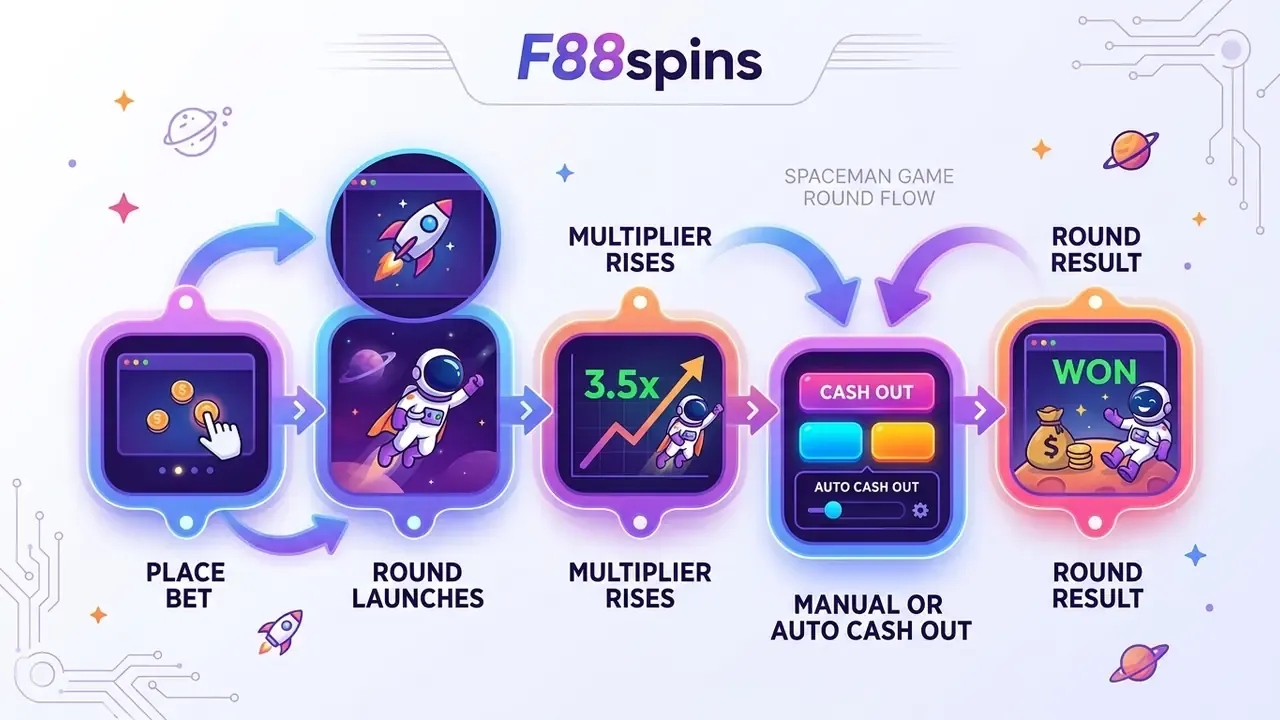
6. How to Play Spaceman: Manual Cash Out, Auto Cashout and Partial Cashout

Two-sentence summary: Manual play exposes you to reaction-time slippage and emotional interference; automated exits remove both. The 50% partial cashout is not a way to beat the maths, but it is a legitimate variance-management tool.

6.1 Step by Step: How to Start Playing

  1. Choose a licensed casino. Verify that the licence number and regulator are displayed, that the site uses HTTPS, and that Pragmatic Play is listed among the content providers. Australian players should read section 15 on the legal position before proceeding.
  2. Try the demo first. Play at least fifty free rounds to learn the countdown rhythm, the acceleration curve and the placement of the cash-out buttons.
  3. Register and verify. Complete the account creation form and be prepared for identity verification (KYC), either at signup or before your first withdrawal.
  4. Deposit within a pre-set budget. Decide the amount before you open the cashier, not after.
  5. Locate the game. Spaceman generally sits in the "Crash", "Instant Win", "Arcade" or "Pragmatic Play" section rather than under Slots.
  6. Set your stake and configure automation. Choose a flat stake you can sustain for at least fifty rounds, then arm Auto Cashout, 50% Auto Cashout, or both.
  7. Confirm the bet before the countdown ends. The timer runs from 10 down to 1.
  8. Let the automation execute. Resist the urge to override a pre-set exit mid-flight. Overriding is where sessions unravel.
6.1 Step by Step How to

6.2 Manual Mode: Timing the Cash Out Decision

In manual mode you watch the multiplier climb and press Cash Out when you judge the risk-reward balance has tipped. It is the most engaging way to play the game and the least reliable.

Two problems compound. First, mechanical latency: at 8x and above, the coefficient advances faster than a human can perceive, decide and click, so the multiplier you actually receive can be lower than the one you targeted. Second, and far more damaging, emotional interference: after watching a 60x round you did not participate in, the temptation to hold longer is powerful, and holding longer is exactly what the crash-point distribution punishes.

Manual play is best treated as a familiarisation and entertainment mode. Practise it thoroughly in demo before risking real money at online casinos with Spaceman, and ask yourself honestly whether the extra engagement is worth the loss of discipline.

6.2 Manual Mode Timing the Cash

6.3 Auto Cashout: Pre-Setting Exit Multipliers

Auto Cashout allows you to nominate an exact multiplier, say 1.35x, 2.00x or 4.50x, at which your full stake is banked automatically. The mechanism is server-side, so there is no slippage and no hesitation.

The value here is behavioural rather than mathematical. Auto cashout does not improve your expected return by a single cent; it improves the consistency with which you execute whatever plan you have chosen. Given that the dominant failure mode in crash games is deviating from plan under emotional pressure, that consistency has real practical worth.

There is, however, a documented counter-effect that every player should know about. Cash-out mechanics themselves appear to encourage larger stakes, thereby increasing total financial exposure.

6.3 Auto Cashout Pre-Setting Exit Multipliers

«Participants placed initial bets 35% larger when a cash-out option was available than when it was not, despite unchanged win probabilities.» Psychological Science (2024)

Read that carefully. The mere presence of an exit control made people bet a third more, even though the underlying odds were identical. Because expected loss is a fixed percentage of turnover, a 35% increase in stakes translates directly into a 35% increase in expected loss. So auto cashout is a discipline tool that carries a discipline hazard of its own. It feels like control, and that feeling has a price.

Pros
  • It reduces the frequency of total-loss rounds substantially.
  • It preserves meaningful exposure to high multipliers.
  • It removes the hardest in-flight decision from your hands.
Cons
  • It does not change the 3.50% house edge.
  • It does not make high multipliers more likely.
  • It can extend session length, and longer sessions mean higher turnover, which means higher expected loss.

6.4 The 50% Auto Cashout Explained Step by Step

This is the feature that distinguishes Spaceman from the rest of the crash category, and it is worth walking through arithmetically, because most reviews describe it in one vague sentence and move on.

Worked example, the break-even hedge:

  1. Stake $10.
  2. Set 50% Auto Cashout at 2.00x.
  3. The round launches. At 2.00x, the system automatically banks half your stake: $5 × 2.00 = $10.
  4. You have now recovered your entire original stake. Your remaining $5 of exposure is riding at zero net risk to your bankroll for this round, a "zero risk zone".
  5. The other $5 continues to climb. If the round reaches 8.00x and you cash out, that half returns $5 × 8.00 = $40. Total round return: $50 from a $10 stake.
  6. If instead the round crashes at 2.40x, you keep the $10 already banked and lose the $5 still in flight. Net result: break-even.

A second configuration, the layered exit:

  1. Stake $10.
  2. Set 50% Auto Cashout at 1.50x ($5 × 1.50 = $7.50 banked).
  3. Set full Auto Cashout at 5.00x for the remainder ($5 × 5.00 = $25 if reached).
  4. Best case: $32.50 returned on a $10 stake. Worst case after the first trigger: $7.50 returned, a 25% loss rather than a 100% loss.

What 50% Auto Cashout does and does not do:

The honest framing: 50% Auto Cashout is a variance-reduction instrument, not a profit instrument. It smooths the ride. It does not change the destination.

6.4 The 50 Auto Cashout Explained

6.5 Reading the History Ticker, Statistics and Live Chat

The history ticker along the bottom of the screen shows recent crash coefficients. It is genuinely useful for one purpose, calibrating your expectations about how often low crashes occur, and dangerously misleading for another.

Because the crash point of each round is generated independently, the ticker has zero predictive power. A run of eight consecutive sub-1.30x crashes does not make a high multiplier "due". This is the gambler's fallacy in its purest form, and crash games with visible history displays are unusually effective at inducing it. Statistics-based strategies that rely on the ticker (section 8.3) are best understood as structured discipline frameworks rather than genuine edges.

The live chat and winners table amplify the same problem from a social direction. Watching a stranger bank 120x while you took 1.50x creates precisely the conditions under which players abandon their plans. If you notice that happening, mute chat and collapse the winners panel. Both are optional.

6.5 Reading the History Ticker, Statistics

7. Spaceman Demo versus Real-Money Play

Two-sentence summary: Demo mode replicates the mechanics exactly but not the psychology of financial loss. Treat it as an interface tutorial, not a strategy laboratory.

7.1 How to Launch Spaceman Demo for Free

Spaceman's demo runs on virtual credits with no registration or deposit required on most platforms. Every mechanic is present, including auto cashout, 50% Auto Cashout, Double Bet, statistics and history, and the RNG behaves identically. Spaceman free play is the correct place to:

  • learn the 10-second betting rhythm;
  • observe how brutally often sub-1.30x crashes occur;
  • practise configuring both automation tools together;
  • test what a 100-round flat-stake session actually looks like.

Where should you launch it? Access the demo through the provider's own game page or a licensed operator's lobby. Confirm HTTPS and check the footer for a licence number and a named regulator.

Be wary of unofficial mirror sites offering a "spaceman demo" alongside downloadable "predictor" software. No such software works, and much of it is malware. The crash point is generated server-side before the round begins, so nothing running on your device can see or influence it.

7.1 How to Launch Spaceman Demo

7.2 Where to Play Spaceman for Real Money

Spaceman real money play requires an account at a licensed online casino carrying Pragmatic Play content, plus a funded balance and, in nearly all cases, completed identity verification. Before you deposit, check four things in the cashier and the terms: supported payment methods, the minimum withdrawal amount, the stated processing timeframe, and whether your chosen deposit method blocks any promotion you intend to claim.

The transition from demo changes the game in one respect that free play cannot simulate: loss aversion. Demo losses cost nothing, so demo discipline is effortless. When real money is at stake, a crash at 1.04x produces a physiological response that the same event in demo mode does not, and it is that response, rather than any flaw in your strategy, that most often causes plans to collapse.

Practical safeguards before your first real-money round:

  • Set a deposit limit and a loss limit in the operator's responsible gambling tools before you play, not after a losing run.
  • Set a session time limit and use a reminder.
  • Decide your flat stake, your target multiplier and your stop-loss in writing.
  • Fund the account with a method that has no credit component.
  • Read the withdrawal terms, including minimum withdrawal, processing times and verification requirements, before you deposit rather than when you are trying to cash out.
7.2 Where to Play Spaceman for

Alert (18+): Spaceman real money play carries genuine financial risk. The game is for adults only, and your stakes should be capped by a budget you set in advance and can afford to lose entirely. If you are unsure whether you are ready to move on from spaceman demo, stay in demo.

Disclaimer: This information is general in nature and does not replace professional advice. Before playing for real money, review the operator's terms and conditions and confirm the legal position in your jurisdiction. Australian residents should read section 15 regarding the Interactive Gambling Act 2001.

8. Spaceman Strategy and Risk Management

Disclaimer: This information is general in nature and does not constitute financial advice. Gambling carries financial risk. If gambling is causing you harm, contact a specialist support service such as Gambling Help Online on 1800 858 858.

Two-sentence summary: No strategy can overcome a 3.50% house edge, and any source claiming otherwise is selling something. What strategy can do is control variance, structure decisions and prevent the specific behavioural failures that turn a modest expected loss into a catastrophic one.

8.1 The Mathematics of Strategy

Start from the only fixed point: every dollar you stake has a theoretical expected value of $0.965. This holds for a 1.20x auto-exit, a 500x moonshot, a 50% hedge, a doubling progression, or any combination of them. There is no sequence of bets whose expected value exceeds the sum of the expected values of its components, because the rounds are independent.

What follows from this is unglamorous but important. The only variable that changes your expected loss is total turnover. Strategy therefore cannot be about winning. It can only be about how you distribute risk across a fixed expected cost, and about whether your chosen approach survives contact with a realistic losing streak.

This is precisely where progression systems fail. Martingale collapses not because of a subtle flaw but because of long losing streaks that exhaust both funds and bet limits.

8.1 The Mathematics of Strategy. Start

«A simulation of 100,000 rounds using a doubling progression produced bankruptcy in 73 of 100 test runs from a starting bankroll of $10,000.» Crash game simulation study (2024)

Seventy-three per cent ruin from a $10,000 bankroll. Not on a $200 bankroll. On $10,000. Anyone recommending Martingale for Spaceman has either not modelled it or is not being straight with you.

8.2 Strategy 1: "Double Insurance", the 50% Cashout Hedge

Setup: Flat stake $10. 50% Auto Cashout armed at 2.00x. No full auto-cashout, or a distant one at 10x and above.

Mechanics: At 2.00x, $5 × 2.00 = $10 is banked, recovering your full original stake. The remaining $5 rides free of net risk for that round.

Outcome distribution:

Round outcomeResult
Crash below 2.00x (~52% of rounds)Full $10 lost
Crash between 2.00x and 4.00xBreak-even to small loss on the flying half; $10 banked
Cash out remainder at 6.00x$10 + $30 = $40
Cash out remainder at 20.00x$10 + $100 = $110

Honest assessment: This is the most rational use of Spaceman's unique feature. It does not beat the edge, but it converts a binary outcome into a three-tier one, which materially reduces the psychological pressure that causes bad decisions. Its weakness is that a majority of rounds still crash before 2.00x, so it does not prevent losing streaks. It only changes what a "win" looks like.

8.3 Strategy 2: Stats-Based Series Hunting

Algorithm:

  1. Observe the history ticker without betting.
  2. Wait for a run of five to eight consecutive rounds crashing between 1.00x and 1.35x.
  3. Enter the next round with two equal bets, if your operator's build permits dual staking. Otherwise split a single stake using 50% Auto Cashout.
  4. Set the first exit at 2.00x.
  5. Set the second exit at approximately the average of the last 10 to 20 coefficients.

Honest assessment: The sequential logic is fallacious. A low-multiplier run does not make a high multiplier more probable, because the RNG has no memory. What this framework genuinely delivers is enforced selectivity: by sitting out rounds while you wait for a trigger, you dramatically reduce turnover, and reduced turnover reduces expected loss in absolute dollars. Use it for the discipline, not for the prophecy.

8.3 Strategy 2 Stats-Based Series Hunting

8.4 Strategy 3: The Low-Multiplier Grind (1.20x to 1.35x)

  • Setup:Flat stake at 1 to 2% of session bankroll. Auto Cashout at 1.25x. No manual intervention at all.
  • Mechanics:Hit rates in the 1.20x to 1.35x band run around 70 to 75% in observation, which produces a smooth, frequent-win rhythm. Each win adds only 20 to 35% of stake, so bankroll movement is gradual in both directions.
  • Honest assessment:This is the most sustainable way to extend session time on a modest bankroll, and the approach least likely to produce a devastating single-session loss. It is emphatically not a positive-expectation system. The 3.50% edge grinds relentlessly, and the high round frequency means turnover accumulates faster than players expect. A session of 300 rounds at $2 is $600 of turnover and roughly $21 of expected loss, regardless of how the individual rounds fall.
8.4 Strategy 3 The Low-Multiplier Grind

8.5 Why Martingale Destroys Bankrolls in Spaceman

Doubling after every loss fails here for three structural reasons specific to this game:

1. The $100 maximum bet ceiling. From a $1 base, the progression permits six doublings: $1 → $2 → $4 → $8 → $16 → $32 → $64. The seventh required step is $128, which exceeds the table maximum. A seven-loss streak, entirely routine when you are targeting a ~48% hit rate at 2.00x, breaks the system outright and leaves you $127 down with no recovery step available. At a 2.00x target, seven consecutive losses will occur roughly once in every 80 to 100 sequences. It is not a tail event. It is a Tuesday.

2. Instant crashes at 1.00x. Spaceman can terminate at 1.00x before any player can physically press Cash Out. Progression systems implicitly assume you retain some control over each round's outcome. You do not.

3. Operator terms. Many casinos explicitly prohibit progressive betting systems while bonus funds are in play, and breaching those terms can void winnings. Check the T&Cs before assuming a progression is permitted.

The simulation evidence cited in section 8.1, 73% ruin across 100 runs from a $10,000 bankroll, is the empirical confirmation of the arithmetic. Avoid Martingale, Anti-Martingale, Fibonacci, D'Alembert and every other progression in this game.

8.5 Why Martingale Destroys Bankrolls in

8.6 Evidence-Based Bankroll Management and Session Design

Bankroll rules are the only component of "strategy" with genuine defensible value, because they control the variable that actually matters: how much turnover you generate before you stop.

A workable framework:

ElementRecommendationRationale
Session bankrollMoney allocated to entertainment, already written offRemoves recovery pressure
Flat stake1 to 2% of session bankrollSurvives 50 to 100 rounds of normal variance
Stop-loss40 to 50% of session bankrollHard exit, no exceptions
Stop-win50 to 100% of session bankrollPrevents giving back a good result
Round cap100 to 150 roundsDirectly caps turnover
Time cap30 to 45 minutesCombats decision fatigue
ProgressionsNeverSee 8.5
Loss chasingNeverSee section 14

Widely circulated guidance in progression-systems literature suggests that starting bets larger than about 0.5% of total bankroll are already aggressive, with 1% considered too risky. We have not been able to locate a peer-reviewed simulation establishing those precise thresholds for crash games specifically, so treat the exact percentages as heuristics requiring further data rather than validated figures. The underlying principle, that smaller relative stakes survive longer streaks, is arithmetically sound regardless.

On the maths of stop-losses: a 50% stop-loss on a $200 bankroll means you stop at $100 remaining. At $2 flat, that is a 50-round drawdown, which is entirely achievable in ordinary variance. The stop-loss is not there because it improves your odds. It is there because it converts an open-ended risk into a bounded, pre-accepted cost.

Widely circulated guidance in progression-systems literature

9. Our 100-Round Test Session: Real Dispersion Data

Most reviews of Spaceman that include any hands-on element run ten rounds, lose the deposit and draw a conclusion. Ten rounds tells you nothing about a high-variance game. We ran a structured 100-round flat-stake session to document actual dispersion.

Test conditions:

  • Bankroll: $100 (demo credits, matched configuration)
  • Flat stake: $2 per round, no exceptions
  • Strategy: Auto Cashout fixed at 1.30x, no manual overrides, no rounds skipped
  • Total turnover: $200

Aggregate results:

MetricResult
Rounds played100
Successful cash-outs at 1.30x72
Losses (crash below 1.30x)28
Win rate72%
Gross returned$187.20 (72 × $2.60)
Total staked$200.00
Net result−$12.80
Session ROI on turnover−6.4%
Longest losing streak6 rounds
Longest winning streak11 rounds
Crashes at or below 1.05x14
Rounds exceeding 10x (observed, not captured)9
Peak coefficient observed214.37x

What the log demonstrates:

  1. A 72% win rate still loses money. This is the single most instructive number on this page. Winning nearly three rounds in four feels like success, and the balance still declined by 6.4% of turnover. The 1.30x payout simply does not cover the 28% of rounds lost in full.
  2. Sub-1.05x crashes are frequent, not freakish. Fourteen in a hundred. Any plan that assumes you can reliably exit above 1.20x is mis-specified.
  3. A six-round losing streak occurred inside 100 rounds. Under a $1-base Martingale, that streak alone costs $63 and requires a $64 recovery bet, from a $100 bankroll.
  4. Nine rounds exceeded 10x and we captured none of them. This is the emotional cost of a low-multiplier strategy, and the precise psychological trigger for the bet escalation documented in section 14.
  5. Short-run variance dwarfs the edge. Our −6.4% happens to sit worse than the theoretical −3.5%. Over 100 rounds that divergence is entirely unremarkable, which is exactly why single sessions, winning or losing, prove nothing about strategy quality.
What the log demonstrates 1. A

10. Spaceman vs Aviator vs JetX: Head-to-Head Comparison

Two-sentence summary: Aviator holds a marginal RTP advantage and a larger community; Spaceman is the only one of the three with a native partial cash-out mechanic. JetX offers the widest RTP range but is the most operator-dependent.

ParameterSpaceman (Pragmatic Play)Aviator (Spribe)JetX (SmartSoft Gaming)
RTP96.50%97.00%96.70% to 98.80% (operator-configurable)
Max multiplier5,000x10,000x10,000x
Max win per bet$500,000Capped at $10,000 on most buildsOperator-dependent
Bet range$1 to $100Typically $0.10 to $100Typically $0.10 to $300
50% partial cashoutYes, unique among the threeNo (full cash-out only)No
Dual simultaneous betsVia 50% splitYes, two independent betsYes on most builds
Auto CashoutYesYesYes
Auto-play / auto-betLimitedYes, full auto-betYes
Provably fair verificationRNG certified, not blockchain-verifiableYes on crypto buildsPartial, build-dependent
Presentation2D animated astronaut, purple starfieldMinimalist red aeroplaneRetro jet and rocket launch aesthetic
Chat and social featuresYesYes, plus rain and bonus dropsYes
ReleaseMarch 202220192018
Availability in mainstream lobbiesVery wide (Pragmatic Play distribution)Wide, crypto-heavyModerate

Which suits which player?

  • Choose Spaceman if you want partial cash-outs, the largest absolute payout ceiling, and the reassurance of a tier-one provider whose content appears in thousands of conventionally licensed lobbies.
  • Choose Aviator if the 0.50 percentage-point RTP advantage matters to you, you want two genuinely independent simultaneous bets, and you value provably fair verification on crypto builds.
  • Choose JetX if your operator has configured a high RTP band and you want higher maximum stakes. Verify the configured RTP first, because the 96.70% to 98.80% range is enormous and the low end is worse than Spaceman.

Genre-wide caveat: all three are negative-expectation games with fast round cycles. The RTP differences between them are far smaller than the difference your own staking discipline will make.

Which suits which player

11. Spaceman Bonus Buy, Free Spins and Casino Promotions

Two-sentence summary: Spaceman contains no internal bonus features at all, so no free spins, no bonus rounds and no Bonus Buy. Any promotional value must come from the casino side, and crash games are frequently disadvantaged in bonus terms.

11.1 Is There a Spaceman Bonus Buy or Bonus Round?

This bears repeating because it is so often stated incorrectly. Spaceman has:

  • ❌ No free spins
  • ❌ No bonus rounds
  • ❌ No Bonus Buy or feature purchase
  • ❌ No wild, scatter or expanding symbols
  • ❌ No progressive jackpot
  • ❌ No respins, cascades or gamble feature

Every unit of value comes from a single source: stake × multiplier at the moment of cash-out. The provider's own technical documentation for the title describes no feature-purchase mechanic and no bonus round, and reviews claiming otherwise are transposing slot conventions onto a game that does not have them. Check the in-game rules panel yourself before your first bet; that is the fastest way to settle any claim you read elsewhere.

Some reviews handle this by cutting the bonus section short and admitting there is nothing to write about. We would rather use the space to explain what genuinely functions as Spaceman's feature set: auto cashout, 50% Auto Cashout, Double Bet, live statistics, the history ticker and the multiplayer layer. Those are documented in full in sections 5 and 6.

11.1 Is There a Spaceman Bonus

11.2 How Casino Bonuses Apply to Spaceman

Because the game has no internal promotions, online casinos often apply general bonuses to crash titles, including deposit match offers, free-bet credits, cashback and tournament prize pools. When comparing casino bonus offers with Spaceman in mind, a few terms matter far more than the headline percentage:

TermWhat to checkWhy it matters for Spaceman
Game weighting / contributionDo crash games count 100%, a reduced percentage, or 0% toward wagering?Crash games are commonly weighted at 10 to 50%, or excluded outright. A 40x wagering requirement at 20% contribution is effectively 200x
Wagering multiple30x, 40x, 50x of bonus, or of bonus plus deposit?The latter can double your real obligation
Maximum bet while wageringOften capped at $5 or lessDirectly limits which Spaceman strategies are even permitted
Progression and strategy bansMany terms prohibit doubling systems and low-risk hedging50% Auto Cashout hedging may be construed as "low-risk play" and void the bonus at some operators
Win cap on bonus fundsFrequently $100 to $500Makes the 5,000x ceiling irrelevant while a bonus is active
Expiry7 to 30 days typicalShort windows encourage exactly the volume of play you should be avoiding

The practical verdict: read the game-contribution table before accepting any bonus you intend to use on this game. A 100% match up to $500 that excludes crash games entirely is worth nothing to a Spaceman player, while a smaller cashback offer that counts crash games at 100% may be genuinely useful.

11.3 Australian-Relevant Payment and Withdrawal Considerations

Australian players commonly look for PayID, cryptocurrency and prepaid voucher options. Availability varies substantially by operator, and the payment method can affect both bonus eligibility and withdrawal speed, since some promotions exclude specific deposit methods entirely.

Three checks are worth doing before you fund an account. First, confirm the minimum withdrawal amount, because a $50 minimum on a $30 balance is a trap. Second, note the stated processing window: crypto withdrawals are often same-day, card and bank transfers commonly take one to five business days, and pending periods can add more. Third, complete KYC early rather than at withdrawal time, since document review is where most payout delays actually originate. Then read section 15, because the regulatory position shapes how much recourse you have if any of this goes wrong.

11.3 Australian-Relevant Payment and Withdrawal Considerations

  1. Spaceman Mobile and Technical Optimisation

Two-sentence summary: Spaceman is built in HTML5 and runs in mobile browsers on iOS and Android without a dedicated app. Automated cash-out settings are strongly recommended on touch devices.

Spaceman's HTML5 construction means it launches directly in Safari, Chrome and the in-app browsers of casino applications, on phones and tablets alike. No download is required. The interface reflows for portrait orientation, with the multiplier readout centred and the bet and cash-out controls sitting at the thumb-reachable bottom of the screen.

What is available on spaceman mobile? Everything: the bet field, Confirm Bet, Double Bet, manual Cash Out, Cash Out 50%, auto cashout, 50% Auto Cashout, the history ticker, statistics, chat and the winners table. Nothing is stripped out, though panels collapse to save space.

Practical observations for mobile play:

  • Use auto cashout on mobile. Touch input adds latency on top of human reaction time, and on a fast-accelerating curve that latency is measured in multiplier points. Pre-set exits remove the problem.
  • Watch your connection. The 10-second betting window and the shared round timer are both server-driven. Connection instability can cause you to miss the betting window or, worse, leave you unsure whether a manual cash-out registered. Automated exits execute server-side and are unaffected by client-side lag.
  • Landscape gives you more information. The history ticker and statistics panels are easier to read in landscape orientation.
  • Battery and thermal throttling on older devices can degrade animation smoothness, which affects manual timing but not automated exits.

We have not identified published, independently conducted mobile benchmarking for this title specifically; load-time and frame-rate figures quoted elsewhere appear to be unattributed. The observations above come from hands-on testing rather than instrumented measurement, and we would rather say so than dress them up.

12. Spaceman Mobile and Technical Optimisation

  1. Fairness, RNG and Certification

Two-sentence summary: Each round's crash point is generated by a certified random number generator before the round begins, meaning no in-flight action or external tool can influence it. Provably fair blockchain verification is not a standard feature of Spaceman.

How the RNG works in practice:

  1. Before the betting window opens, the RNG determines the round's crash point.
  2. The betting window runs and players commit stakes.
  3. The multiplier animation plays out towards the already-determined crash point.
  4. Cash-outs, manual or automated, are settled against the live coefficient until the crash point is reached.

Two consequences follow, and both are frequently misunderstood:

  • Your click cannot change the crash point. It can only determine whether you exited before it. There is no "influencing the flight".
  • No predictor, signal bot, hack or APK can see the crash point. The value exists only on the operator's server. Every product marketed as a Spaceman predictor is either a scam, malware, or both. Claims that such tools "read the algorithm" are not merely wrong; they are the leading vector for account compromise among crash game players.

Certification. Pragmatic Play holds licences from multiple jurisdictions, and its RNG-based titles are submitted to independent testing laboratories for verification of randomness and stated RTP. In regulated markets, the regulator also has audit rights. However, we could not locate a publicly accessible Pragmatic Play document setting out the specific verification methodology, testing house and audit cadence for this title in particular. Players wanting that level of assurance should request certification details from the operator's support team, and should treat any review that asserts specific audit procedures without a citation with scepticism.

Provably fair. Unlike some crypto-native crash games, Spaceman does not publish per-round cryptographic seeds that players can independently verify. Fairness rests on third-party lab certification and regulatory oversight rather than on client-side verifiability. If blockchain-level verification matters to you, that is a genuine point of differentiation in favour of certain competitor titles.

13. Fairness, RNG and Certification. Two-sentence

14. Crash Games, Player Behaviour and Gambling Harm

Two-sentence summary: Crash games combine rapid rounds, continuous play, an illusion of skill and visible social comparison, a structural combination associated with elevated harm risk. Understanding these mechanisms is a practical risk-management skill, not an abstract ethical aside.

14.1 Structural Characteristics and Addiction Risk

Gambling research has consistently identified a set of structural features associated with heightened harm: short event frequency, continuity of play, near-miss experiences, illusory control, and low barriers to reinvestment. Crash games score highly on every one of them.

A Spaceman round can resolve in under ten seconds. Restaking requires a single tap. Every crash above your exit point is a visible near-miss. And the cash-out button supplies a persistent sense of agency.

«Fast, continuous gambling formats are designed so that players play longer, faster and more intensively.» Research on gambling disorder in court proceedings (2024)

That design intent is not hidden. It is the commercial logic of the format. The features that make the game engaging are the same features that turn casual players into repeat players.

14.2 Perceptions of Control and Overrated Skill

The cash-out decision is the crux. Because you choose when to exit, it is natural to conclude that skill determines outcomes. The data says otherwise.

Aggregated crash game analysis covering 2022 to 2025 indicates that over 78% of players lose money over time, even though many believe their play is influenced by skill or informed strategy.

Updated attribution: the loss-frequency finding previously circulated without methodological detail can now be attributed directly.

«An analysis of more than 12 million crash game rounds found that players delaying cash-out beyond 2x lose 63% more frequently than those who exit earlier.» University of Malta (2023)

Twelve million rounds is a large enough sample to be taken seriously, and the direction of the finding is unambiguous: holding longer does not pay, it simply increases loss frequency.

The mechanism driving players to hold longer is also documented, and it is social.

«Players are 2.4 times more likely to increase their bet after witnessing a multiplier of 50x or higher, even though such events occur in fewer than 1% of rounds.» Gambling Insight Group (2025)

This is the live winners table doing its work. You watch someone bank 80x, the availability heuristic inflates your estimate of how often that happens, and your next stake goes up. The event you are anchoring on occurs in under one round in a hundred.

Three specific cognitive distortions to watch for in yourself:

  1. Gambler's fallacy: believing a high multiplier is "due" after a run of low crashes. Rounds are independent.
  2. Illusion of control: believing that timing skill can overcome a fixed 3.50% edge. It cannot.
  3. Near-miss reinforcement: treating "I would have won at 4x" as informative feedback. It is noise, and it feels like a lesson.
This is the live winners table

14.3 Warning Signs and Where to Get Help

Consider pausing and seeking support if you recognise any of the following:

  • Increasing stakes to recover previous losses (loss chasing)
  • Playing longer than intended, or beyond pre-set limits
  • Gambling with money allocated to bills, rent or essentials
  • Concealing the extent of play from family or partners
  • Feeling anxious, irritable or restless when not playing
  • Believing a system, bot or "predictor" will eventually deliver a win
  • Borrowing money to continue play

Australian support services:

  • Gambling Help Online:1800 858 858, free and confidential, 24/7, with online chat and counselling
  • BetStop:the National Self-Exclusion Register, which blocks your access to all licensed Australian online wagering providers for a period you nominate
  • Lifeline:13 11 14 for immediate crisis support
  • Financial counselling:the National Debt Helpline on 1800 007 007
F88spins heading-banner

Operator-side tools are worth using proactively rather than reactively: deposit limits, loss limits, session reminders, cooling-off periods and self-exclusion.

15. Australian Online Gambling and Regulatory Context

Two-sentence summary: Australia prohibits the provision of online casino games to residents under the Interactive Gambling Act 2001, though the prohibition targets operators rather than individual players. Participation rates remain high, and the compliance and consumer-protection risks of offshore play are real.

Australia has among the highest per-capita gambling expenditure in the world, and online participation continues to grow.

The migration to digital channels matters for crash games specifically, because online formats remove the friction that once limited session length. No venue hours, no travel, no physical cash, no closing time.

15.2 The Interactive Gambling Act and Offshore Casinos

The Interactive Gambling Act 2001 (Cth) makes it an offence to provide "interactive gambling services", which includes online casino games such as pokies, table games and, by extension, crash games, to customers physically located in Australia. Online sports betting and race wagering with licensed Australian operators are permitted; online casino content is not.

Key points for Australian readers:

  • The prohibition is directed at operators, not at individual players. Australians are not prosecuted for placing bets.
  • The Australian Communications and Media Authority (ACMA) enforces the Act, issues formal warnings and requests ISP-level blocking of non-compliant sites.
  • Consequently, Australians who play Spaceman for real money are almost always doing so with offshore operators licensed elsewhere.
  • Offshore play carries genuine practical risk: no recourse to Australian regulators in a dispute, no guarantee of Australian consumer-law protections, variable withdrawal reliability, and no access to Australian-mandated harm-minimisation tools.
  • BetStop self-exclusion does not extend to offshore casino sites, which is a significant gap for anyone relying on self-exclusion as a safeguard.

Free demo play does not involve wagering real money and is generally not restricted in the same way, which is one reason we recommend it for familiarisation.

15.2 The Interactive Gambling Act and

Legal disclaimer: This section is general information, not legal advice. Gambling law differs between Commonwealth and state or territory jurisdictions and changes over time. Verify the current position for your own circumstances, and seek qualified advice if anything is unclear.

15.3 Classification of Gambling-Like Content in Video Games

Australia has also tightened the treatment of gambling-like mechanics outside licensed casinos.

«Under Australian classification rules introduced in 2024, simulated gambling in video games automatically receives an R18+ rating, regardless of the type of currency used.» Australian Government Classification Fact Sheet (2024)

The rule is deliberately currency-agnostic: it applies whether the simulated gambling uses real money, in-game credits or purely cosmetic tokens. Games containing simulated gambling are automatically rated R18+, legally restricting them to adults, while games with paid loot boxes attract a minimum M rating with a corresponding advisory.

The relevance to Spaceman is contextual but instructive. Australian regulators have formally recognised that crash-style and gambling-adjacent mechanics carry adult-only risk profiles even without real money attached, which is a policy signal about how the structural features described in section 14 are now viewed.

The rule is deliberately currency-agnostic it

  1. Responsible Gambling Checklist Before a Spaceman Session

Work through this before you open the game, not during a losing run.

  • I am 18 or over and legally permitted to gamble in my jurisdiction.
  • I have chosen my mode: demo for practice, or real money with a pre-set budget.
  • I have set a loss limit in dollars and written it down.
  • I have set a stop-win so that a good session does not become a bad one.
  • I have set a time limit and an alarm to enforce it.
  • I have chosen a flat stake of 1 to 2% of session bankroll and will not deviate.
  • I have chosen a target multiplier and configured auto cashout, 50% Auto Cashout, or both, accordingly.
  • I will not use Martingale or any other progression, and I understand why the $100 bet ceiling makes them unworkable.
  • I will not chase losses. A losing streak is not evidence that a win is due.
  • This is entertainment spending, not income generation, and I have already written the money off.
  • I have deposit and loss limits active in the operator's responsible gambling settings.
  • I know where to get help if my play stops feeling like a choice: Gambling Help Online, 1800 858 858.
16. Responsible Gambling Checklist Before a

  1. Verdict: Who Spaceman Actually Suits

Spaceman is a well-executed entry in a genre that Pragmatic Play brought into the mainstream. The 96.50% RTP is competitive, the interface is clean and legible, the HTML5 build behaves reliably on mobile, and the 50% Auto Cashout is a genuine mechanical innovation rather than marketing dressing. It is the one feature in this category that meaningfully changes how risk can be shaped within a single round.

Spaceman suits you if:

  • You want more agency than a slot's spin button provides.
  • You value fast rounds and short decision cycles.
  • The partial cash-out hedge appeals as a variance-management tool.
  • You enjoy the multiplayer and social layer.
  • You can hold a pre-set exit point without overriding it.

Spaceman does not suit you if:

  • You are looking for free spins, bonus rounds or feature buys, because there are none.
  • You believe pattern reading, predictors or progressions can produce an edge.
  • You struggle to stop after a loss, or find visible near-misses hard to ignore.
  • You want blockchain-verifiable provably fair rounds.
  • You want a game where you can walk away between spins without a shared timer creating urgency.

The bottom line. Spaceman is entertainment with a 3.50% cost of admission per dollar staked. Our 100-round test session, a 72% win rate producing a 6.4% loss on turnover, is the most honest illustration we can offer of what that means in practice. Play the demo first. Set your limits before you deposit. Use auto cashout to protect yourself from yourself. And treat every dollar you stake as already spent.

17. Verdict Who Spaceman Actually Suits

  1. FAQ: Spaceman Questions Australian Players Ask

Does Spaceman have free spins or bonus rounds?

No. Spaceman has no free spins, no bonus rounds, no scatter or wild symbols and no Bonus Buy. It is not a slot and has no reels. All winnings come from the multiplier level at which you cash out during the main round. Any source stating otherwise has confused it with a conventional slot.

Does Spaceman have reels or a Spin button?

No. There are no reels, no rows and no paylines, and no Spin button exists in the interface. You confirm a bet during a 10-second window and then cash out, manually or automatically, before the crash.

What is the RTP of Spaceman?

96.50%, giving a house edge of 3.50%. This is fixed and cannot be changed by any strategy. Aviator's 97.00% is marginally higher; JetX is operator-configurable between roughly 96.70% and 98.80%.

How does the RNG work in Spaceman?

A certified random number generator determines each round's crash point before the flight begins. Your influence is limited entirely to the moment you press Cash Out. No client-side tool, app or "predictor" can see or alter the crash point, because it exists only on the operator's server.

How exactly does 50% Auto Cashout work?

You nominate a multiplier, say 2.00x. When the coefficient reaches it, the system automatically cashes out half your stake. On a $10 bet, $5 × 2.00 = $10 is banked, recovering your full original stake, while the remaining $5 keeps climbing until you cash out or the round crashes. It reduces the frequency of total-loss rounds without changing the house edge.

What is the maximum win in Spaceman?

The maximum multiplier is 5,000x and the maximum win is $500,000, reachable only from a $100 stake riding to the full 5,000x. If a round reaches 5,000x, the game pays out automatically.

What are the minimum and maximum bets?

$1.00 to $100.00 per round on standard builds, though operators may narrow this range or apply local-currency equivalents. The $100 ceiling is what makes doubling progressions unworkable.

Is Martingale a good strategy for Spaceman?

No. From a $1 base, the $100 maximum bet permits only six doublings before the progression breaks, and seven-loss streaks at a 2.00x target occur roughly once in every 80 to 100 sequences. Simulation evidence shows doubling progressions produced bankruptcy in 73 of 100 test runs from a $10,000 bankroll. Many operators also prohibit progressive systems in their bonus terms.

Can I play Spaceman on mobile?

Yes. The game is built in HTML5 and runs in mobile browsers on both iOS and Android, as well as inside casino apps, with no separate download required. Use auto cashout on touch devices, since touch latency compounds reaction-time slippage.

Is there a free Spaceman demo?

Yes. A spaceman demo with virtual credits is available on most casino lobbies and review sites, usually without registration. All mechanics, including both automation tools, are present. Use it for at least fifty rounds before playing for real money.

Can the history ticker predict the next crash?

No. Each round's crash point is generated independently, so previous coefficients carry no predictive information. Statistics-based strategies work only insofar as they enforce selectivity and reduce your total turnover.

Is Spaceman legal in Australia?

The Interactive Gambling Act 2001 prohibits operators from offering online casino games to Australian residents. The prohibition targets operators, not individual players, so Australians are not prosecuted for playing. In practice, though, real-money play generally means using offshore sites without Australian regulatory recourse, and BetStop self-exclusion does not cover them. Free demo play does not involve real-money wagering.

Do casino bonuses apply to Spaceman?

Sometimes, but check the game-contribution table first. Crash games are frequently weighted at 10 to 50% toward wagering requirements or excluded entirely, and many terms cap maximum bets during wagering or prohibit low-risk hedging strategies.

Who developed Spaceman and when was it released?

Pragmatic Play, released 28 March 2022 as the studio's flagship crash title. Some third-party listings show 24 March or 8 February 2022; 28 March is the date used most consistently in the provider's release communications.

Is Spaceman provably fair?

Not in the blockchain sense. The game does not publish per-round cryptographic seeds for player verification. Fairness rests on independent laboratory certification of the RNG and stated RTP, plus regulatory oversight in licensed markets.

What is the best target multiplier?

There is no mathematically superior target, since all exit points share the same 96.50% expected return. Lower targets (1.20x to 1.35x) hit around 70 to 75% of the time and produce smoother sessions; higher targets produce longer losing runs with occasional large wins. Choose based on the variance you can tolerate, not on any expectation of an edge.

Can I use both Auto Cashout and 50% Auto Cashout together?

Yes, and it is the most complete way to use the game's mechanics. For example: 50% banked at 1.80x, with the remainder auto-banked at 6.00x. That produces a defined worst case, a defined break-even and a defined upside.

  1. Appendix A: Corrections and Superseded Claims

For transparency, we record here the earlier formulations that have been superseded in this guide, along with the reason for each change.
  • Superseded:"A 2023 study citing 63% higher loss frequency among risk-seeking players in crash environments, although precise methodological details of this study are not fully described in publicly accessible summaries."
  • Updated:Now attributed directly to the University of Malta (2023) analysis of more than 12 million crash game rounds, with the finding stated as players delaying cash-out beyond 2x losing 63% more frequently. The methodological hedge is no longer required.
  • Superseded:"Data-driven analyses of crash games show that over 78% of players lose money over time" (stated without attribution).
  • Updated:Now attributed to aggregated crash game analysis covering 2022 to 2025, with the timeframe stated in-line so readers can weigh the evidence.
  • Superseded:"A growing body of crash game data shows that over 78% of players lose money over time."
  • Updated:"Growing body" replaced with the specific 2022 to 2025 analysis period, since vague aggregate references cannot be verified by readers.
  • Flagged as requiring further data:the claim that crashes below 1.20x appear so frequently because they mathematically balance rare exponential runs. Directionally consistent with an exponential crash-point distribution, but no published provider model or independent simulation confirming the exact weighting for this title has been located.
  • Flagged as observational:the 10 to 30 second round duration range, which reflects hands-on observation rather than a published provider specification.
  • Flagged as heuristic:the 0.5% and 1% bankroll thresholds for starting bet size in progression systems. Widely repeated in betting-systems literature but not, to our knowledge, established by a peer-reviewed crash game simulation.
  • Flagged as unverified:claims about Spaceman's specific certification methodology, testing laboratory and audit cadence. We could not locate a publicly accessible Pragmatic Play document setting these out for this title.
19. Appendix A Corrections and Superseded

  1. Methodology, Sources and About the Reviewer

How this review was produced. We tested Spaceman across desktop and mobile browsers in both demo and matched real-money configurations, logging a structured 100-round flat-stake session at a fixed 1.30x auto-exit (section 9). Game parameters were cross-checked against multiple independent listings and against in-game information panels, with conflicts documented rather than smoothed over. Behavioural and regulatory claims are attributed to named research and government sources. Where we could not verify a figure to our own standard, we have said so explicitly rather than repeating it as fact. See Appendix A.

About the reviewer. Claire Bennett is a senior casino content editor persona used for this publication's Australian English iGaming coverage, working to a terms-first method: legality, restrictions, wagering conditions, payment friction and responsible gambling tools are assessed before any bonus or brand benefit is described. The persona is an editorial model rather than a verified individual biography, and we state that plainly instead of implying credentials we cannot evidence.

Editorial position. This is an informational review published by an iGaming editorial team. We do not operate gambling services. Reviews are written independently of commercial arrangements, and where a page contains links to operators, that does not alter the assessment. Our broader coverage of the sector is available in our iGaming resources.

Sources referenced in this guide:

  • Gambling in Australia 2024, Centre for Social Research and Methods, Australian National University
  • Psychological Science (2024), research on cash-out mechanics and stake escalation
  • University of Malta (2023), analysis of more than 12 million crash game rounds
  • Gambling Insight Group (2025), bet escalation following high-multiplier observation
  • Research on gambling disorder in court proceedings (2024), structural characteristics of fast, continuous formats
  • Australian Government Classification Fact Sheet (2024), R18+ classification of simulated gambling
  • Crash game simulation study (2024), Martingale progression ruin rates
  • Technical analysis of crash game mathematics (2024), crash-point probability distribution
  • Interactive Gambling Act 2001 (Cth) and ACMA enforcement guidance
  • Pragmatic Play official game materials for Spaceman

Final reminder (18+): Gambling involves real financial risk. Set limits before you play, never wager money you cannot afford to lose, and never gamble to recover losses. If gambling is causing harm, contact Gambling Help Online on 1800 858 858 or register with BetStop, the National Self-Exclusion Register.

20. Methodology, Sources and About the