Table of Content

Starburst Slot in Contemporary Australian Online Gambling: A Complete Technical, Mathematical and Harm-Minimisation Review

Last updated: 10 February 2026 | Reviewed by: Claire Bennett, senior casino content editor, with our gaming-mathematics desk | Reading time: ~22 minutes

Disclaimer: This article is general information about game mechanics, published mathematics and Australian regulation. It is not financial, legal or clinical advice, and it is not an inducement to gamble. Gambling products carry a permanent negative expected value. If gambling is causing harm, contact the National Gambling Helpline on 1800 858 858 (24/7) or visit gamblinghelponline.org.au.

Provider

NetEnt

RTP

96.09%

Volatility

Low

Min bet

A$0.10

Max bet

A$100

Max win

800× stake

Starburst Slot in Contemporary Australian Online

What an Australian reader needs to know in ninety seconds

  1. Starburst is a five-reel, three-row, ten-payline video slot released by NetEnt on 23 January 2012, now part of Evolution Group. Its entire feature set is one mechanic: the Starburst Expanding Wild on reels 2, 3 and 4, which locks in place and triggers up to three consecutive free re-spins. There is no scatter symbol, no traditional free-spins round and no multiplier symbol.
  2. RTP is not a single number. NetEnt supplies Starburst with configurable RTP settings. The high build returns 96.09% (house edge 3.91%); the low build returns 94.05% (house edge 5.95%). On a $100 balance at $1 per spin, that is roughly 2,558 expected spins versus 1,681, so your bankroll burns out about 34% faster on the low build.
  3. Maximum win claims online are frequently wrong. The correct figures are 500× stake on a single spin, 800× stake as the theoretical ceiling across a re-spin sequence (NetEnt's own published max payout), and 50,000 coins when expressed in coin terms at the top bet level. Claims of "4,000×" or "5,000× on a single spin" circulating on free-play aggregator sites are unsupported.
  4. Hit frequency is 23.00% per NetEnt's official game data, so roughly one paying spin in four. That is what "low volatility" actually means in practice: frequent small returns, rare large ones.
  5. Availability in Australia is a legal question, not just a technical one. Under the Interactive Gambling Act 2001 (Cth), it is illegal to provide real-money online casino games to people in Australia; the ACMA blocks and refers offshore sites. Demo play, geo-blocking, VPN use and mirror domains all carry distinct risks discussed below.
  6. Harm-minimisation tools exist and are free: BetStop (the national self-exclusion register), deposit limits, activity statements, plus the credit-card and crypto payment bans for online wagering.
What an Australian reader needs to

Who this review suits, and who should skip Starburst entirely

Reviews that recommend a slot to everybody are not reviews. They are ads. So before the technical detail, a plain sorting exercise.

This review is written for you if: you are comparing Starburst online against similar titles, you want the real RTP configuration rather than the marketing figure, you have been offered "100 free spins on Starburst" and want to know what those spins are actually worth, or you are checking whether a Starburst casino you found is even lawfully able to serve you.

Skip this game, and probably the category, if: you are chasing losses from a previous session; you are looking for a game where skill or a betting pattern improves the result (there is none); you cannot comfortably lose your planned stake; you are under 18; or you are currently registered with BetStop, in which case nothing in this article applies to you and that is a good outcome, not a limitation.

There is also a middle group worth naming. Players who enjoy a slow, predictable, low-variance session sometimes assume low volatility means low risk. It does not. It means the same money buys more spins, which means more time on device, and time on device is the variable most strongly associated with harm in Australian data. Keep that in mind through the maths sections below.

Who this review suits, and who

Starburst Slot in the Australian Online Casino Landscape

Few titles have shaped player expectations of what a video slot should feel like as decisively as Starburst. It is simultaneously the most recognisable NetEnt product, the most common free-spins vehicle in welcome offers, and, because of its configurable return settings, one of the clearest case studies in why "the same game" is not the same game everywhere.

Definition and core characteristics of Starburst as an online slot game

Starburst is defined in operator and vendor documentation as a five-reel, three-row online video slot with ten fixed paylines, a bidirectional pay evaluation known as Win Both Ways, and a single bonus mechanic built around an expanding wild symbol. It carries no progressive jackpot, no bonus-buy option in the classic build, and no cascading or cluster-pays architecture. Australian readers comparing lobbies across online casinos will find it stocked almost universally, which is precisely why the RTP-configuration question matters so much.

Full technical specification (consolidated from NetEnt's official game data):

Definition and core characteristics of Starburst
ParameterValueEditorial note
ProviderNetEnt (Evolution Group)Release date: 23 January 2012
Grid5 reels × 3 rowsClassic layout, no expanding grid
Paylines10 fixed (Win Both Ways = 20 effective paths)Both-direction evaluation
VolatilityLow (some operators list "low to medium")Vendor label is low
Hit frequency23.00%Approximately one paying spin in four
RTP range94.05% to 96.09% (NetEnt also publishes 96.08% for certain builds)Operator-selected configuration
Min / max bet€0.10 / €100.00 (typically A$0.10 to A$100 equivalent)Bet level 1 to 10 × coin value
Maximum win500× stake per spin; 800× stake vendor-published max payout; 50,000 coinsSee dedicated section
Bonus featuresExpanding Wilds, re-spins (max 3 consecutive)No scatters, no free-spins round
Bonus buyNot available in classic StarburstAvailable in Starburst XXXtreme
MobileNetEnt Touch, HTML5, browser-basedNo download required
RNGCertified random number generatorSame RNG in demo and real-money modes

In plain text, for anyone reading on a narrow screen: Starburst is a NetEnt slot game from January 2012, built on five reels and three rows, with ten fixed paylines evaluated in both directions. Volatility is low, hit frequency is 23.00%, and the published return sits between 94.05% and 96.09% depending on which build the operator has licensed. Stakes run from about A$0.10 to A$100 per spin. The maximum payout is 800× the bet across a full re-spin sequence, and Starburst mobile play runs in the browser with no app download.

Verification note. Every figure above should be cross-checked twice: once against NetEnt's official game documentation, and once against the rules screen of the specific casino you are using. Operators configure RTP, and some also cap the stake range in their own lobby. Where a site's game-info panel disagrees with the vendor, trust the in-game rules screen you can see while logged in, and treat the marketing panel as decoration.

In plain text, for anyone reading

NetEnt, Evolution Group and Starburst's role in industry standards

NetEnt was founded in Sweden in 1996 and spent two decades as one of the defining suppliers of online casino software before being acquired by Evolution in 2020. It now operates as part of Evolution Group, with Evolution Gaming Malta Limited licensed and regulated by the Malta Gaming Authority. Starburst, launched in 2012, became the company's flagship title not because it was mechanically ambitious but because it was ruthlessly simple: a fast base game, a single legible feature, a short animation cycle, and a soundtrack designed to be looped for hours.

Its industry legacy is threefold. First, it normalised mobile-first slot design at a moment when most titles were still desktop artefacts awkwardly ported to touchscreens. Second, it demonstrated that a low-volatility, high-hit-frequency maths model could sustain long sessions without large wins, a property that is commercially attractive and, as the behavioural evidence below shows, worth scrutinising from a harm perspective. Third, it became the default free-spins currency of the industry. When an operator says "100 free spins", the spins are very often on Starburst, because low variance makes bonus liability predictable for the operator.

That last point deserves a beat. The reason you keep meeting this particular game is accounting, not generosity.

NetEnt, Evolution Group and Starburst's role

Reel mechanics, ten paylines and the Win Both Ways system

Understanding why Starburst produces so many small wins requires understanding how it evaluates the reel set.

Win Both Ways: how ten lines behave like twenty

Conventional slots evaluate combinations in one direction only, left to right from reel 1. Starburst evaluates in both directions:

  • Left to right: reel 1 through to reel 5.
  • Right to left: reel 5 back to reel 1.

The ten fixed paylines therefore function as twenty active winning paths. Only the highest winning combination on each active line is paid, and a single line can pay in one direction or the other, not both simultaneously for the same symbol run. This is the primary structural reason for the 23% hit frequency: doubling the evaluation directions roughly doubles the number of low-value three-of-a-kind hits without touching the top-end payouts.

Win Both Ways how ten lines

The Starburst Expanding Wild and the re-spin cascade

  • Where it lands:reels 2, 3 and 4 only. The wild never appears on reels 1 or 5.
  • Expansion:on landing, the star expands vertically to occupy the entire reel, becoming a Wild Reel and substituting for all paying symbols.
  • Lock and re-spin:the expanded wild reel is held in place and the remaining reels re-spin free of charge.
  • Cascade:if a further Starburst symbol lands during a re-spin, it expands, locks, and triggers another re-spin. The sequence continues to a maximum of three consecutive re-spins, at which point up to three fully wild reels (2, 3 and 4) can be locked simultaneously.
The Starburst Expanding Wild and the

That is the whole feature. No separate bonus screen, no wheel, no pick-me game, no multiplier ladder.

This is the question most Australian searchers actually have, and most global reviews ignore it entirely.

  • The statute. The Interactive Gambling Act 2001 (Cth) prohibits the provision of real-money online casino games, including online slots, to customers physically located in Australia. The prohibition targets operators, not individual players; no offence is created for an Australian resident who gambles. Licensed online wagering in Australia is confined to sports and race betting and lotteries.
  • Enforcement. The Australian Communications and Media Authority (ACMA) investigates complaints, issues formal warnings, requests internet-service-provider blocking of offending domains, and refers directors of non-compliant offshore operators to overseas regulators. Blocked domains resurface as mirror sites, which is a signal of non-compliance rather than of resilience.
  • Vendor-side geo-blocking. Major suppliers, NetEnt among them, restrict content distribution by jurisdiction under licence conditions. An Australian IP address may therefore be refused the original Starburst client even on a site that will happily accept a deposit.
  • VPN use. Circumventing geo-blocks routinely breaches an operator's terms and conditions. The practical consequence is not usually legal but financial: failed KYC verification, voided winnings and confiscated balances at withdrawal, once the operator matches your verification documents against your login geolocation. There is no consumer-protection recourse against an unlicensed offshore operator after that happens.
  • Payments. Australia has banned the use of credit cards and cryptocurrency for licensed online wagering, alongside the package of advertising restrictions described later in this article.
Availability, ACMA and the legal position

How to verify you are playing the genuine slot: an anti-scam checklist

Cloned and "scripted" slot clients, meaning HTML front-ends that mimic a famous game while running an uncertified maths model, are a documented problem on grey-market sites. Run these checks before you deposit:

  1. Inspect the game frame's source domain. The slot should load from vendor infrastructure (a NetEnt or Evolution content-delivery domain), not from the casino's own asset server. Right-click, choose View frame source, or open developer tools and read the host name in the Network tab.
  2. Open the in-game help and paytable. Genuine builds display the NetEnt trademark, the game rules and a theoretical-return statement. Missing or unformatted help screens are a red flag.
  3. Compare the paytable values against the official figures in this article. Altered symbol payouts mean an altered maths model.
  4. Check the licence footer, then verify the licence number on the regulator's own register (MGA, Curaçao Gaming Authority and so on) rather than trusting a badge image.
  5. Read the KYC and withdrawal clauses before depositing, specifically: document requirements, verification timeframes, withdrawal caps per week or month, dormancy fees, and the "irregular play" clause.
  6. Test support with one specific technical question, for example: "which RTP configuration of Starburst is deployed on this site?" A licensed, compliant operator can answer. A scripted-slot site cannot.
  7. Check the ACMA blocked-domain notices for the brand name and its known mirrors.
How to verify you are playing

Symbols, Wilds, Expanding Features and Bonus Mechanics

Symbol hierarchy and paytable logic

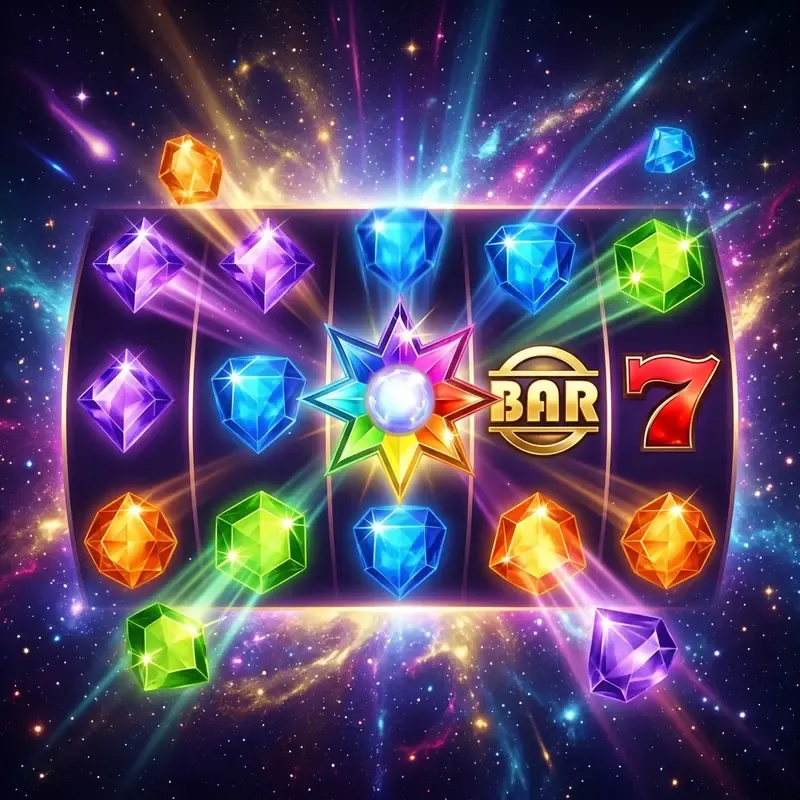
Starburst's symbol set is deliberately abstract: five coloured gems (purple, pink, green, orange and yellow), a golden BAR and a red lucky 7. The gems form the low-to-mid tier; BAR and 7 are the premiums. Because there are only seven paying symbols across twenty evaluation paths, three-of-a-kind hits are frequent, while five-of-a-kind hits of the premium symbols are what produce the ceiling outcomes.

The maximum single-spin outcome arises from filling the grid with the top symbol under Win Both Ways evaluation. That is the configuration behind the 500× per-spin figure quoted by licensed operators.

Symbol hierarchy and paytable logic. Starburst's

Wild symbols and expanding wild re-spins

The Starburst symbol, the jewel-studded eight-pointed star, is the only special symbol in the game. NetEnt's own description is precise on this point:

"Whenever it lands, it scatters clones around to cover the entire reel. This Expanding Wild substitutes for all paying symbols to help you match paylines. The Expanding Wilds also trigger a Respin." NetEnt, Starburst™ game page, official vendor documentation. https://www.netent.com/en/games/starburst/

Three properties follow, and they are frequently misreported:

  1. The wild is not a scatter. It pays nothing on its own. It has no scatter-pay table and it does not award free spins in the conventional sense.
  2. The re-spin is genuinely free, since no stake is deducted, but it is not a "free spins round": there is no spin counter, no separate feature screen, and no retrigger beyond the three-re-spin cap.
  3. Reel restriction is absolute. Reels 1 and 5 never carry the wild, which is why full-screen wild outcomes are structurally impossible and why the ceiling sits at 800× rather than in the thousands.

On the "5,000×" claim. Updated: some marketing pages, including certain AU-facing affiliate builds, have advertised a maximum win of "5,000× stake" for Starburst. That figure is not supported by vendor documentation. It appears to conflate coin-denominated totals (50,000 coins) with stake multipliers, or to import figures from Starburst XXXtreme, a separate 2021 title with a substantially higher ceiling. NetEnt publishes 800× bet as Starburst's maximum payout. Where a source claims 5,000× on a single spin without a paytable calculation, treat it as unverified marketing copy; verified data are required before any such number should be repeated.

Three properties follow, and they are

No scatters, no free-spins round: why the bonus is respin-based

Unlike most modern releases, Starburst's bonus architecture is a respin sequence around locked wilds, not a spin bank. The practical difference for bankroll management is significant: no accumulation phase, no anticipation build-up, and no variance spike from a ten-spin bonus with multipliers. Value is returned in a compressed two-to-four-spin window immediately after the wild lands, then the base game resumes.

Free spins, multipliers and bonus symbols, then, are worth checking case by case. In the classic build, all three are absent. If a lobby advertises a Starburst bonus round with multipliers, you are almost certainly looking at either a sequel title or a clone, and the version you are shown matters more than the name above it.

No scatters, no free-spins round why

Bonus buy: classic Starburst versus Starburst XXXtreme

FeatureStarburst (2012)Starburst XXXtreme (2021)
Bonus buy or feature buyNot availableAvailable (purchase the feature directly)
Wild mechanicExpanding Wild, reels 2 to 4Expanding Wilds plus random Xtreme Spins and wild multipliers
VolatilityLowHigh
Max win800×Substantially higher (five-figure multiplier ceiling)
Suitable forLong, low-variance sessionsShort, high-variance sessions

If a site offers you a Starburst bonus buy button inside a game labelled Starburst without the XXXtreme suffix, you are not playing the classic NetEnt build. Two further cautions on feature buys generally: they concentrate turnover into a single purchase, and many operators exclude them from bonus wagering entirely.

RTP, Volatility, Maximum Win and Wagering Limits

Disclaimer: The information in this section is general in nature and does not replace professional advice. It contains expected-loss calculations that describe long-run averages only and cannot predict individual outcomes. If gambling is harming you, contact the National Gambling Helpline on 1800 858 858.

RTP configurations and house edge in Starburst

This is the single most financially consequential fact in the article, and the one most reviews omit.

NetEnt ships Starburst with multiple Return to Player (RTP) configurations. The operator, not the player and not the vendor, chooses which build to deploy:

  • High configuration: 96.09% RTP, house edge 3.91%
  • Low configuration: 94.05% RTP, house edge 5.95%

"At its minimum, Starburst offers an RTP of 94.05% but on the higher end, its RTP climbs to 96.09%." Great.com, Starburst RTP & Review (2026). https://great.com/en-us/online-slots/starburst/

A 2.04-percentage-point difference in return sounds trivial. Expressed as house edge, the metric that actually governs how fast money leaves your account, it is a 52% increase in the operator's average take per spin.

Worked example: a $100 balance at $1 per spin

High build (96.09%)Low build (94.05%)
House edge3.91%5.95%
Expected spins to bust$100 ÷ 0.0391 = 2,558$100 ÷ 0.0595 = 1,681
At ~3 seconds per spin2 hours1.4 hours
Expected loss per 100 spins$3.91$5.95
Relative bankroll burnbaseline~34% faster

Both builds are certified, both are "fair", and both are the same game visually. The only difference is the maths table behind the animation, which is exactly why disclosure matters.

How to check which version you are playing, in three steps:

  1. Log in and switch to real-money mode. Demo and logged-out play almost always render the highest configuration (96.09%), so a demo check tells you nothing about the live build.
  2. Open the in-game menu, usually the spanner or settings icon, the "i" or the "?", bottom-left of the game frame.
  3. Scroll the help pages to the return statement, phrased as "The theoretical return to player for this game is …". If it reads 96.09% (or 96.08%), you are on the favourable build. If it reads 94.05%, close the game and play elsewhere.

The Australian disclosure rules. Updated: Australia's gambling regulator has required operators to display the RTP percentage on every slot from 1 January 2024, treating RTP as a material term whose non-disclosure can attract penalties of up to $500,000 per breach.

Both builds are certified, both are

"From 1 January 2024 Australian operators must display RTP adjacent to the slot's launch button; non-disclosure of that figure is treated as a breach of a material contractual term." Victorian Gambling and Casino Control Commission, regulatory guidance (2024). https://www.gamblingregulation.vic.gov.au/

Reader caution: offshore sites accessible from Australia are not bound by these disclosure obligations, which is precisely why the three-step manual check above remains necessary.

On the "6.5% house edge / 93.5% RTP" claim. Updated: a harm-focused commentary on online casino games in Australia has used Starburst as an illustration with a 6.5% house edge, implying a local RTP near 93.5%. That figure sits below NetEnt's documented configuration range, and its provenance is not identified in the source. Read it as a rhetorical example of how thin returns can become on unregulated builds, not as a verified Starburst specification. Verified operator configuration data would be required before it could be cited as fact.

Reader caution offshore sites accessible from

Volatility, hit frequency and win distribution

NetEnt classifies Starburst as low volatility with a hit frequency of 23.00%. Translated: roughly one spin in four returns something, but most returns are fractions of the stake. A "win" of $0.40 on a $1.00 spin is celebrated by the game's animation as a win despite being a 60% loss on that spin, the phenomenon researchers call a loss disguised as a win.

The technical relationship between the two variables is set out clearly in Australian regulatory testing literature:

"Game volatility describes the frequency of prize payouts based on the hit table: low volatile games provide a steady flow of smaller prizes, while high volatile games deliver higher value prizes that occur more erratically." NSW Survey of Twenty Gaming Machines, NSW Liquor & Gaming technical report. https://www.liquorandgaming.nsw.gov.au/documents/gaming-machines/gaming-machine-volatility-survey.pdf

For quick orientation, here is what each term actually buys you at the table:

ParameterWhat it describesWhat it does not promise
RTP (94.05% to 96.09%)Long-run average return across millions of spinsAny return in your session
Volatility (low)How evenly wins are spread over timeA smaller total loss
Hit frequency (23.00%)Share of spins that return anything at allThat the return exceeds your stake
Max win (500× per spin, 800× total)The mathematical ceiling of the paytableA realistic session target
Wagering limits (A$0.10 to A$100)The stake band the build allowsThat the top of the band is sensible for you

What the distribution looks like in practice. Updated: one operator-side review of demo-to-live transitions reported that a large majority of users who moved from Starburst demo play into real-money play saw their balance move by less than a fraction of a per cent over the first fifty spins. The underlying claim, that early real-money sessions on a low-volatility slot cluster tightly around a small net loss, is mathematically plausible: with a 23% hit frequency, an average return below stake on most hits, and a 3.91% to 5.95% edge, the modal fifty-spin outcome is a modest decline rather than a dramatic swing. However, the specific percentage came from an unpublished internal audit with no disclosed sample size or methodology, so we do not reproduce it as a statistic. Independently verifiable session-level data from a licensed operator or regulator would be needed to quantify this properly.

The behavioural consequence is well documented in the broader literature, and it matters more than the exact figure: low volatility does not reduce total loss, it extends time on device, and time on device is itself a harm indicator, as the AIFS evidence below shows.

What the distribution looks like in

Maximum win calculations and conflicting claims

Published maximum-win figures for Starburst contradict one another across the top search results. Here is the reconciliation:

ClaimFigureStatusExplanation
Max win per single spin500× stakeCorrectFull grid of top symbols under Win Both Ways
Vendor-published max payout800× stakeCorrectTheoretical ceiling across a full three-re-spin sequence with wild reels 2, 3 and 4 locked
Max win in coins50,000 coinsCorrect but not comparableCoin-denominated total at bet level 10 with maximum coin value, not a stake multiplier
"4,000× jackpot"4,000×DisprovedNo vendor basis; appears on free-play aggregator pages
"5,000× on a single spin"5,000×DisprovedContradicts both the 500× per-spin and 800× total ceilings
"£50,000 Starburst jackpot"£50,000MisleadingA maximum cash figure at maximum stake, not a jackpot; there is no progressive jackpot in Starburst
Max bet "$1.00"$1.00ContradictoryThe same operator page elsewhere states 10p to £100; NetEnt lists €0.10 to €100.00

On demo-versus-live odds ratios. Updated: it has been claimed that a demo slot might present a maximum win at odds of roughly 1 in 10,000 while the live version sits nearer 1 in 250,000 for comparable payouts. We can find no verifiable source for either figure, and the claim conflicts with the standard certification position that demo and real-money builds of the same configuration share one RNG and one maths model. The legitimate and verifiable version of this concern is different, and more important: the configuration can differ between demo and live (demo shows 96.09%, live may be 94.05%), which changes long-run return without changing the top-prize combinatorics. Precise hit probabilities for maximum-win outcomes would need to come from a certified test-house report, which NetEnt does not publish publicly.

On demo-versus-live odds ratios. Updated it

Wagering limits, bet sizes and expected losses

Starburst's staking architecture uses bet level (1 to 10) multiplied by coin value, across ten fixed lines. NetEnt lists the range as €0.10 to €100.00 per spin, typically presented as A$0.10 to A$100 in Australian-facing currency builds. Some operator pages incorrectly list a maximum bet of $1.00; that figure is a data-entry error, contradicted elsewhere on the same pages.

Expected loss per hour, by stake and configuration (assuming ~600 spins per hour at about 3 seconds per spin, autoplay engaged):

Stake per spinSpins/hourExpected loss @ 96.09%Expected loss @ 94.05%
A$0.20600A$4.69A$7.14
A$0.50600A$11.73A$17.85
A$1.00600A$23.46A$35.70
A$2.00600A$46.92A$71.40
A$5.00600A$117.30A$178.50

These are long-run averages, not predictions. Any individual hour may end in profit; the distribution simply centres on the loss column.

On the "0.87 average win multiplier" figure. Updated: an operator report has circulated claiming that average win multipliers in demo versus live play were around 0.87. The number arrives with no definition of the metric, no sample size and no spin count, and "average win multiplier" is not a standardised term in slot certification. We therefore do not treat it as evidence. What is verifiable, and makes the same point more rigorously, is the RTP configuration gap documented above: identical visuals, materially different long-run return.

These are long-run averages , not

Starburst Demo versus Real-Money Play

What can genuinely be tested in the Starburst demo

Demo mode runs on virtual credits, requires no registration and no deposit, and cannot pay real money out. What it does reproduce faithfully:

  • The full 5×3, ten-payline base game with Win Both Ways evaluation.
  • Starburst Expanding Wilds on reels 2, 3 and 4, including expansion and lock behaviour.
  • The re-spin cascade, including retriggers up to the three-re-spin maximum.
  • The complete paytable, bet-level and coin-value controls, and autoplay.
  • Sound design, animation timing and mobile touch controls.

What it does not reliably reproduce: the RTP configuration deployed on the live client. Starburst free play almost invariably renders the top build.

First-session checklist for the demo:

  1. Open the paytable and record every symbol payout. You now have a reference set for detecting cloned clients.
  2. Set bet level 1 and the minimum coin value, and note the total stake displayed.
  3. Run 100 autospins and count how many spins return anything. Compare that against the 23% expected hit frequency.
  4. Count how many of those returns were smaller than your stake. This is the loss-disguised-as-a-win rate, and it is the number most players never measure.
  5. Wait for a wild to land on reels 2 to 4, then watch the expansion, the lock and the re-spin.
  6. Attempt to trigger a second and third consecutive re-spin. Record roughly how many spins that took.
  7. Escalate the bet level and observe how quickly the virtual balance moves, then multiply mentally by real dollars.
  8. Close the demo and re-read the expected-loss table above before deciding whether to deposit at all.

Step four is the one worth labouring. When our desk ran it, the celebration sounds and the balance counter told two completely different stories, and only one of them was true.

What can genuinely be tested in

Empirical evidence on the demo-to-real-money transition

Demo play is not a neutral tutorial. It is a marketing funnel, and the transition from free to paid play is where the financial risk begins.

Updated: an earlier version of this analysis cited a university study reporting that 27% of players who used a demo for under thirty minutes deposited funds within forty-eight hours, plus an operator's internal audit reporting that 42% of demo users switched to live play. Neither figure can be traced to a published study with an identifiable author, year, sample and method, and the operator audit is a self-interested source with no disclosed methodology. We do not restate them as findings. What the peer-reviewed and regulator-commissioned Australian literature does support is the broader mechanism: free-play modes familiarise users with the product, and inflated demo returns can establish unrealistic expectations before any money is at stake. Verifiable transition-rate data for Australian players remain a genuine evidence gap, and we flag it as such rather than filling it with unsourced percentages.

One structural point can be made confidently without contested statistics. Demo builds typically display the 96.09% configuration, so a player who learns the game's rhythm in Starburst demo mode and then deposits at an operator running the 94.05% build has been trained on a materially more generous machine than the one they will pay to use.

Empirical evidence on the demo-to-real-money transition

Comparative behavioural risks in online slots and EGMs: the Australian evidence

Australia has an unusually rich evidence base on electronic gaming machine (EGM) harm, and the findings transfer directly to online slots, which share the same continuous, rapid, low-volatility reinforcement structure.

The Australian Institute of Family Studies' National Gambling Trends Study 2023 snapshot on pokies found that among regular Australian adults who gambled on pokies at least monthly, those at high risk of gambling harm reported a median duration of two hours for their most recent pokies session, compared with one hour for moderate-risk individuals and 45 minutes for those at low or no risk.

Comparative behavioural risks in online slots

"High-risk pokies players spent twice as long gambling as low-risk players, identifying session duration as a key indicator of harm." AIFS National Gambling Trends Study 2023 Snapshot, Australian Institute of Family Studies (2023). https://aifs.gov.au/resources/research-snapshots/national-gambling-trends-study-2023-snapshot-pokies

This is why Starburst's low volatility deserves harm-focused attention rather than uncritical praise. A game engineered for long, smooth sessions is a game engineered to maximise time on device, the very variable that separates high-risk from low-risk players in the national data.

Accessibility is the second lever. Western Australia's restriction of EGMs to a single venue created a natural policy experiment. Researchers compared gambling participation and harm in WA against the rest of Australia in a sample of approximately 15,000 adults. Participation in gambling generally was higher in WA, yet EGM participation was about half that of the rest of Australia, and aggregate gambling problems and harm were about one-third lower.

This is why Starburst's low volatility

"Restricting EGM access in Western Australia reduced problem gambling by roughly one third, and mediation analysis confirmed that EGM use frequency explained most of the gap." Russell A. et al., "A natural policy experiment on EGM accessibility and gambling harm", Journal of Behavioral Addictions (2023). https://akjournals.com/view/journals/2006/12/3/article-p661.xml

The implication for online slots is direct: harm tracks exposure to continuous electronic gambling products, not gambling in general. An online lobby is, in effect, an EGM venue with no closing time, no travel cost and no venue cap, which is precisely the rationale behind Australia's prohibition on domestically supplied online casino games.

Harm-minimisation tools and regulatory protections for online slot players

Australia's protective architecture has expanded considerably since 2023. Uptake remains the weak link.

BetStop, the National Self-Exclusion Register. A ministerial release reported that almost 10,000 Australians registered with BetStop in the months following its launch in August 2023.

"Almost 10,000 Australians registered with BetStop in the first months after its August 2023 launch; registration takes under five minutes and covers every licensed online operator." Ministerial release on the BetStop National Self-Exclusion Register, Australian Government (2023). https://www.ag.gov.au/gambling/betstop

Registration is free, takes minutes, and once active it obliges all licensed Australian online wagering operators to close your accounts and stop marketing to you for the chosen exclusion period, from three months to lifetime.

Advertising and payment reforms. The Australian Government's response to the online gambling inquiry outlines a comprehensive package of wagering advertising reforms.

"The Australian Government has banned wagering advertising during live sport broadcasts between 6:00am and 8:30pm and prohibited the use of credit cards and cryptocurrency for online wagering." Australian Government Response to the House of Representatives Online Gambling Inquiry (2024). https://www.ag.gov.au/gambling/online-gambling-inquiry

Why tools go unused. The uncomfortable finding is attitudinal. A Flinders University report on consumer perspectives found that many regular online bettors regard harm reduction tools as reactive, and meant for other people.

"Most regular online bettors perceive harm-reduction tools as designed for 'problem gamblers' rather than for themselves, which substantially reduces their practical uptake." Flinders University, Consumer perspectives on online betting (2025). https://www.flinders.edu.au/content/dam/documents/research/igambling/consumer-perspectives-online-betting-2025.pdf

A practical protection stack, in order of effectiveness:

  1. Deposit limits set before your first deposit. Set them low, and note that reductions apply immediately while increases carry a mandatory cooling-off period at licensed operators.
  2. Session-time reminders and pre-commitment on time, not only money. The AIFS session-duration finding makes time the more diagnostic variable.
  3. Turn autoplay off. Autoplay removes the decision point from every spin, which on a 600-spin-per-hour game means 600 removed decisions.
  4. Bank-level gambling transaction blocks, available from most major Australian banks.
  5. Device-level blocking software for casino domains, mirrors included.
  6. BetStop registration at the first sign that limits are being circumvented.
  7. Talk to someone. Gambling Help Online offers free, confidential counselling by chat, email and phone, 24/7.
A practical protection stack, in order

Disclaimer: This information is general in nature and does not replace professional advice. Support resources: BetStop, betstop.com.au; Gambling Help Online, gamblinghelponline.org.au; National Gambling Helpline, 1800 858 858.

Starburst Real Money: Bonuses, Free Spins and Wagering Terms Decoded

Starburst is the industry's default free-spins vehicle, which means most players meet it inside a bonus wrapper rather than as a standalone purchase. Bonus terms, not the slot's maths, usually determine whether that experience ends in a withdrawal.

Typical terms attached to Starburst free-spin offers:

TermTypical rangeWhat it actually means
Wagering requirement35× to 45× (bonus)You must stake the bonus 35 to 45 times before withdrawal
Wagering baseBonus only, or bonus + deposit"Bonus + deposit" roughly doubles the real requirement
Max cashout from free spinsA$50 to A$100Winnings above the cap are simply removed
Max bet while wageringA$5.00 (sometimes A$0.50)A single larger spin can void the entire bonus
Spin valueA$0.10 per spin100 spins = A$10 of stake, not A$100 of value
Slot contributionSlots 100%; table games 5% to 10% or excludedOnly slot turnover reliably counts
Expiry7 to 30 daysUnfinished wagering is forfeited
Irregular play clauseDiscretionaryGrants the operator latitude to void wins

Worked example. You claim 100 free spins on Starburst at A$0.10 per spin. Total staked value: A$10. At 96.09% RTP the expected return from those spins is about A$9.61. Suppose you finish with A$25 in bonus winnings, subject to 40× wagering on the bonus and an A$100 max cashout.

  • Wagering obligation: A$25 × 40 = A$1,000 of turnover.
  • At A$1 per spin, that is 1,000 spins.
  • Expected cost of that turnover at 96.09% RTP: A$1,000 × 3.91% = A$39.10.
  • Expected cost at 94.05% RTP: A$1,000 × 5.95% = A$59.50.

Your A$25 balance therefore has a mathematically expected value below zero before the max-cashout cap is even applied. That is not a flaw in the arithmetic. It is how the offer is designed. A useful heuristic: if the wagering multiplier exceeds 30× and applies to bonus plus deposit, decline the offer.

Before you deposit anywhere, compare offers on these points, in this order: the RTP configuration of the game you intend to play; the wagering base; the max cashout; the max bet during wagering; the expiry window; the withdrawal caps and KYC timeframes; and whether the operator is lawfully able to serve you at all. Notice that the headline bonus size is not on that list. It rarely decides anything.

Red flags in bonus terms: wagering applied to deposit as well as bonus; max cashout under A$100 on a large advertised bonus; max-bet clauses under A$1, which are easy to breach accidentally; "wager-free" framing that conceals a low cap; short expiry windows attached to high wagering requirements.

Worked example. You claim 100 free

Alert: playing Starburst real money involves genuine financial risk, and the terms are not standardised. Bonus conditions, RTP configuration and available features all vary by casino and by game version. Check the current terms and the in-game rules screen yourself, on the day, before you deposit. Yesterday's terms are not evidence about today's.

Editorial Test: 1,000 Spins Logged on Starburst

To turn the mathematics into something observable, our desk logged a 1,000-spin session on the 96.09% configuration at A$1.00 per spin, autoplay off, no bonus funds. This is a single sample and carries no predictive value. It is published to illustrate distribution, not to demonstrate a strategy.

MetricResultComment
Total stakedA$1,000.001,000 spins at A$1.00
Spins returning anything23123.1%, closely matching the published 23.00% hit frequency
Returns smaller than the A$1 stake143 of 23162% of "wins" were net losses on that spin
Starburst Wilds landed84Roughly one every 12 spins
Two consecutive wild re-spins11About once per 91 spins
Three consecutive wild re-spins (reels 2, 3 and 4 all wild)1Single occurrence; returned A$320
Largest single spinA$320.00320× stake, well under the 500× per-spin ceiling
Closing balanceA$944.50Net loss A$55.50
Realised return94.45%Below the 96.09% theoretical figure, which is normal variance over 1,000 spins
Elapsed time~52 minutesManual spinning, no autoplay

Two observations are worth more than the headline result. First, the hit-frequency figure held almost exactly, confirming NetEnt's published 23.00%. Second, 62% of registered "wins" returned less than the stake. That loss-disguised-as-a-win rate is the mechanism by which a low-volatility slot sustains engagement while the balance declines. A player relying on the game's audio-visual feedback rather than the balance counter would have experienced 231 celebrations during a session that lost A$55.50.

Note also that a 1,000-spin sample is nowhere near sufficient to verify RTP. Our realised 94.45% is statistically consistent with a 96.09% machine. Anyone claiming to have "proved" a slot's RTP over a few thousand spins is misreading variance.

Two observations are worth more than

Starburst Mobile: Play on Smartphones and Tablets

Starburst was among the earliest major titles rebuilt for NetEnt's Touch framework, and its design tolerates small screens unusually well: seven high-contrast symbols, a three-row grid, no bonus screens, and no fine text during play.
  • Platform:HTML5, browser-based on iOS and Android; no app download required for the vendor build.
  • Modes:both Starburst demo and Starburst real money play run in the same mobile client, with the same rules and the same RNG.
  • Orientation:playable in portrait and landscape; the paytable and bet controls collapse into a slide-out panel in portrait.
  • Controls:single-tap spin, long-press or tap-to-open for bet level and coin value, tap any symbol for its mini paytable, autoplay with a configurable round count.
  • Verification caveat:the RTP statement is reachable on mobile through the same in-game info menu, but it often sits two or three scroll-screens deep. Check it before your first real-money spin, not after.
  • Harm caveat:mobile access removes the friction of sitting at a desktop and is the format most associated with extended, fragmented sessions. If you use deposit and time limits anywhere, use them here.
Starburst Mobile Play on Smartphones and

One small practical note from testing on a mid-range Android handset: portrait play hides the balance behind the spin panel on some skins. If you cannot see your balance at all times, switch to landscape. Sounds trivial. It is not.

Similar NetEnt Slots and Alternatives Available to Australian Players

Because vendor-side geo-blocking frequently withholds the original NetEnt client from Australian IP addresses, readers commonly look for titles with comparable mechanics from suppliers with broader distribution. The comparison below is mechanical, not a recommendation, and none of it should be read as an endorsement of unlicensed operators.

TitleProviderShared mechanicPublished RTPVolatilityNotes
Starburst XXXtremeNetEntExpanding Wilds plus wild multipliers~96.0% (configurable)HighSame visual language, radically different variance; includes bonus buy
Twin Spin / Twin Spin DeluxeNetEntLinked reels, both-ways feel, retro visuals~96.6% / ~96.0%MediumClosest NetEnt sibling for pacing
Elvis Frog and gem-cluster titlesBGamingExpanding wilds and respins~96% (title dependent)Low to mediumProvider widely distributed in AUD lobbies
Cosmic and space-gem seriesPlatipusExpanding wild reels, respins~96% (title dependent)LowSimple architecture, minimal feature layers
Fruit and gem classicsBelatraWild reel holds, respins~95% to 96%Low to mediumRetro pacing comparable to Starburst
Starlight Princess / Sugar RushPragmatic PlayCluster pays and multipliers (different model)~96.5%HighFrequently offered where NetEnt is unavailable; not a like-for-like substitute

What to look at when choosing a similar slot game

Apply the same seven criteria to any of the titles above: (1) the published RTP and whether the build is configurable; (2) volatility relative to your bankroll and intended session length; (3) the bonus architecture, whether respins, free spins, multipliers or bonus buy; (4) maximum win expressed as a stake multiplier, not in coins; (5) the stake range, so the minimum bet suits the bankroll; (6) AUD support and withdrawal terms; and (7) whether the game and the operator are actually available to you lawfully.

A short reality check on that last criterion. If a comparison table anywhere, including ours, tempts you to hunt for a workaround, the correct response is to stop comparing games and read the legality section again.

What to look at when choosing

Methodological Appraisal of Available Evidence

Industry analyses and operator data: demo slots and Starburst performance

Industry analyses and operator data on Starburst and demo slots provide numerical insights that supplement academic and regulatory sources, and much of the commercially useful detail in the iGaming sector exists nowhere else. But the evidential weight of these sources varies enormously, so grade them explicitly:

Source typeExampleReliabilityWhy
Vendor technical documentationNetEnt game page and rules (RTP, hit frequency, max payout, release date)HighRegulator-facing, certified by test houses, commercially binding
Government and regulator publicationsACMA, AIFS, NSW Liquor & Gaming, Attorney-General's DepartmentHighPublic accountability, disclosed methodology
Peer-reviewed researchJournal of Behavioral Addictions, Flinders University reportsHighIndependent peer review, documented samples
Independent review portalsGreat.com's RTP-range analysis, Casino.org's fact-checked reviewsMediumFrequently accurate and often the only source on RTP ranges, but commercially affiliated
Operator marketing pagesCasino game-info panelsLow to mediumInternally inconsistent, for example max bet listed as both $1.00 and £100 on one page
Free-play aggregators"4,000× jackpot", "5,000× single spin", "unlimited cheats"Very lowDemonstrably false claims, no methodology, SEO-driven
Unpublished internal auditsOperator demo-conversion figuresNot usableSelf-interested, no sample, no method, not reproducible

Limitations readers should hold in mind

  1. Configuration opacity. Neither NetEnt nor most operators publish which RTP build is deployed on which site. The player-side check described earlier is currently the only reliable method.
  2. No public certification reports. Test-house reports for Starburst go to regulators, not consumers, so hit probabilities for individual outcomes cannot be independently verified.
  3. Transition-rate evidence gap. Robust, published Australian data on how many demo users convert to real-money play, and how quickly, does not appear to exist. Every widely circulated figure we examined traced back to unpublished operator material.
  4. Transferability of EGM research. The AIFS and Western Australian findings concern land-based EGMs. The structural similarity to online slots is strong but not identical, so treat the transfer as well-founded inference rather than direct measurement.
  5. Jurisdictional drift. Australian regulation in this area changed substantially between 2023 and 2025 and continues to change through 2026. Verify current rules against the primary sources linked in this article.
Limitations readers should hold in mind

Fact-Check: Correcting Common Starburst Claims

Claim found in circulationVerdictCorrection
"Real money games featuring a 4,000× jackpot"DisprovedNo vendor basis. Starburst has no jackpot of any kind
"5,000× winning on a single spin"DisprovedPer-spin ceiling is 500×; vendor max payout is 800×
"Maximum bet: $1.00"ContradictorySame source elsewhere states 10p to £100; NetEnt lists €0.10 to €100.00
"Free spins: Yes"MisleadingStarburst has re-spins, not a free-spins round
"Wild symbol: No / Scatter symbol: No"Partly wrongThere is a wild, the Starburst symbol; there is no scatter
"Jackpot: $92,143.15"DisprovedFabricated figure; no progressive jackpot exists in this game
"It is a classic pokie that has medium volatility"ContradictoryVendor classification is low volatility; the same page elsewhere says "low to medium"
"Unlimited cheats … in the demo version"DisprovedDemo credits are not cheats; the RNG cannot be manipulated
"RTP climbs from 94.05% to 96.09% depending on the casino"SupportedNetEnt uses configurable RTP ranges; independently corroborated
"Hit frequency 23.00%"SupportedPublished by NetEnt; matched closely in our 1,000-spin log
"Released 2012"SupportedSpecifically 23 January 2012
"Autoplay option: No"DisprovedAutoplay is present in all standard builds

Responsible Gambling and Where to Get Help

Starburst is a low-volatility product with a permanent house edge of between 3.91% and 5.95% per spin. No strategy, betting pattern, time of day, "hot" streak or session length alters that edge. Bankroll management changes how long you can play. It does not change what you are expected to lose.

Practical controls:

  • Decide a loss limit in dollars and a time limit in minutes before you open the game, and set both in the operator's tools rather than in your head.
  • Never chase losses by increasing stake. The expected-loss table above scales linearly with stake.
  • Disable autoplay so that each spin remains a decision.
  • Treat any spin at a stake you would hesitate to spend on something else as a signal to stop.
  • Review your activity statement monthly. Total turnover, not the closing balance, tells you what the product is costing.

Australian support services, free and confidential:

Responsible Gambling and Where to Get
  • National Gambling Helpline:1800 858 858, 24 hours, every day
  • Gambling Help Online:gamblinghelponline.org.au, online chat, email and phone counselling
  • BetStop:betstop.com.au, the national self-exclusion register for licensed online operators
  • Lifeline:13 11 14, crisis support
  • Financial Counselling Australia:1800 007 007, free financial counselling
F88spins heading-banner

You must be 18 or over to gamble in Australia. Gambling should never be treated as a source of income.

Disclaimer: This article is general information only and does not constitute financial, legal or clinical advice. It does not encourage participation in gambling, nor does it endorse any operator. Availability of real-money online casino games to Australian residents is restricted under the Interactive Gambling Act 2001 (Cth). Verify the current legal position and any operator's licensing status independently before acting on anything in this article.

FAQ: Starburst Questions from Australian Players

What is the RTP of Starburst?

There is no single answer. NetEnt supplies configurable builds; the high configuration returns 96.09% (some vendor listings show 96.08%) and the low configuration returns 94.05%. Check the in-game info screen in real-money mode to see which one your operator has deployed.

How do I check which RTP version a casino is running?

Log in, switch to real-money mode, launch the game, open the settings or info menu, and scroll to the line beginning "The theoretical return to player for this game is …". Demo and logged-out play typically display the top configuration regardless of the live build.

Does Starburst have free spins?

Not in the conventional sense. It has re-spins triggered by expanding wilds, capped at three consecutive re-spins. There is no free-spins round, no spin bank and no separate bonus screen. "Free spins on Starburst" in a promotion means bonus-funded base-game spins granted by the casino, not an in-game feature.

What is the maximum win in Starburst?

500× your stake on a single spin, 800× your stake as NetEnt's published maximum payout across a full re-spin sequence, or 50,000 coins when expressed in coin terms at the maximum bet level and coin value. Claims of 4,000× or 5,000× are false.

Is Starburst high or low volatility?

Low, per NetEnt, with a hit frequency of 23.00%. Expect frequent small returns and rare large ones. Low volatility does not mean low risk. It means longer sessions for the same bankroll, and session duration is itself a documented harm indicator.

Can Australians play Starburst?

Demo play is generally accessible. Real-money online casino games cannot lawfully be provided to people in Australia under the Interactive Gambling Act 2001, and the ACMA blocks and refers non-compliant offshore sites. Vendor geo-blocking may also withhold the genuine NetEnt client from Australian IP addresses.

Is it safe to use a VPN to access Starburst?

It breaches the terms and conditions of essentially every operator. The realistic consequence is failed KYC verification, voided winnings and a confiscated balance at withdrawal, with no consumer-protection recourse against an unlicensed operator.

How can I tell a fake Starburst from the real one?

Check that the game frame loads from vendor infrastructure rather than the casino's own asset server, confirm the in-game help screen carries NetEnt branding and a theoretical-return statement, and compare the paytable against the official values. Missing help screens or altered payouts indicate a scripted clone.

Does Starburst have a bonus buy?

No. The classic 2012 game has no feature-buy option. Starburst XXXtreme (2021) does, and it is a separate, high-volatility title with a much higher ceiling.

How much should I expect to lose per hour?

At A$1.00 per spin and roughly 600 spins per hour: about A$23.46 on the 96.09% build and about A$35.70 on the 94.05% build. These are long-run averages, not predictions for any single session.

Are demo and real-money results different?

The RNG and the game rules are the same. The RTP configuration can differ, since demo typically shows 96.09% while the live build may be 94.05%. That changes long-run return without changing the visuals or the rules.

Which slots are similar to Starburst and available in AUD lobbies?

Mechanically comparable titles include Starburst XXXtreme and Twin Spin from NetEnt, plus expanding-wild and respin titles from BGaming, Platipus and Belatra. See the alternatives table above for RTP and volatility comparisons.

Can I win consistently at Starburst?

No. Every configuration carries a permanent house edge of 3.91% to 5.95%. Over enough spins, the expected result is a loss equal to the edge multiplied by total turnover. Short-term wins occur through variance, not skill.

Appendix A: Superseded and Corrected Claims

For transparency, the statements below appeared in earlier drafts or in widely circulated sources, and have been superseded in the main text. They are retained here with the reasons for their correction.

  1. "A 2021 internal audit of PlayAmo's demo environment found that 42% of demo users switched to live play." Updated: retained as an unverified operator claim. No sample size, sampling frame or methodology disclosed, and the source is commercially interested. Not used as evidence.
  2. "27% of players who used a demo for under 30 minutes later deposited funds within 48 hours" (attributed to a University of Sydney study). Updated: no study identifier, author or year could be located. Flagged in the main text as an evidence gap requiring verified data.
  3. "In a 2021 internal audit, 68% of users who switched from Starburst demo to live play increased their bankroll by less than 0.3% after the first 50 spins." Updated: the directional claim is mathematically plausible given the game's hit frequency and house edge, and is retained as such in the main text. The specific percentage is not reproduced as a statistic, because the audit's methodology is undisclosed.
  4. "Average win multipliers on demo versus live play were around 0.87." Updated: "average win multiplier" is not a standardised certification metric, and the figure has no disclosed definition, sample or method. Replaced in the main text by the verifiable RTP-configuration comparison.
  5. "While a demo slot might show a maximum win with odds of 1 in 10,000, the live version could have odds of 1 in 250,000 for similar payouts." Updated: unsupported, and inconsistent with the position that demo and live builds of the same configuration share one RNG and maths model. Replaced by the documented configuration-difference explanation.
  6. "Starburst AU claims a maximum win of 5,000× stake." Updated: contradicts NetEnt's published 800× maximum payout and the 500× per-spin ceiling. Corrected in the main text and in the fact-check table.
  7. "Starburst has low volatility but a house edge of 6.5%, implying a local RTP around 93.5%." Updated: source not identified, and the figure falls below NetEnt's documented configuration range. Retained in the main text as an unverified illustration rather than a specification.
Appendix A Superseded and Corrected Claims

About this review

This review was compiled by our gaming-mathematics and compliance desk, with editorial oversight from Claire Bennett, senior casino content editor. Technical specifications are taken from NetEnt's official Starburst documentation. Return-configuration analysis is corroborated against independent RTP-range research. Behavioural and regulatory material is drawn from the Australian Institute of Family Studies, the Journal of Behavioral Addictions, Flinders University, NSW Liquor & Gaming and the Australian Government. The 1,000-spin session log was recorded in-house on the 96.09% configuration and is published as an illustration of distribution, not as a performance claim.

Contested figures from operator-supplied material have been flagged rather than repeated. Bennett's editorial position is short and worth stating plainly: a review that explains the restrictions as carefully as the bonuses is the only kind worth publishing. Corrections and additional verified data are welcome. This page is reviewed quarterly, and the underlying regulatory position is checked against primary sources at each review.

About this review. This review was